Common Sowthistle Identification & Control
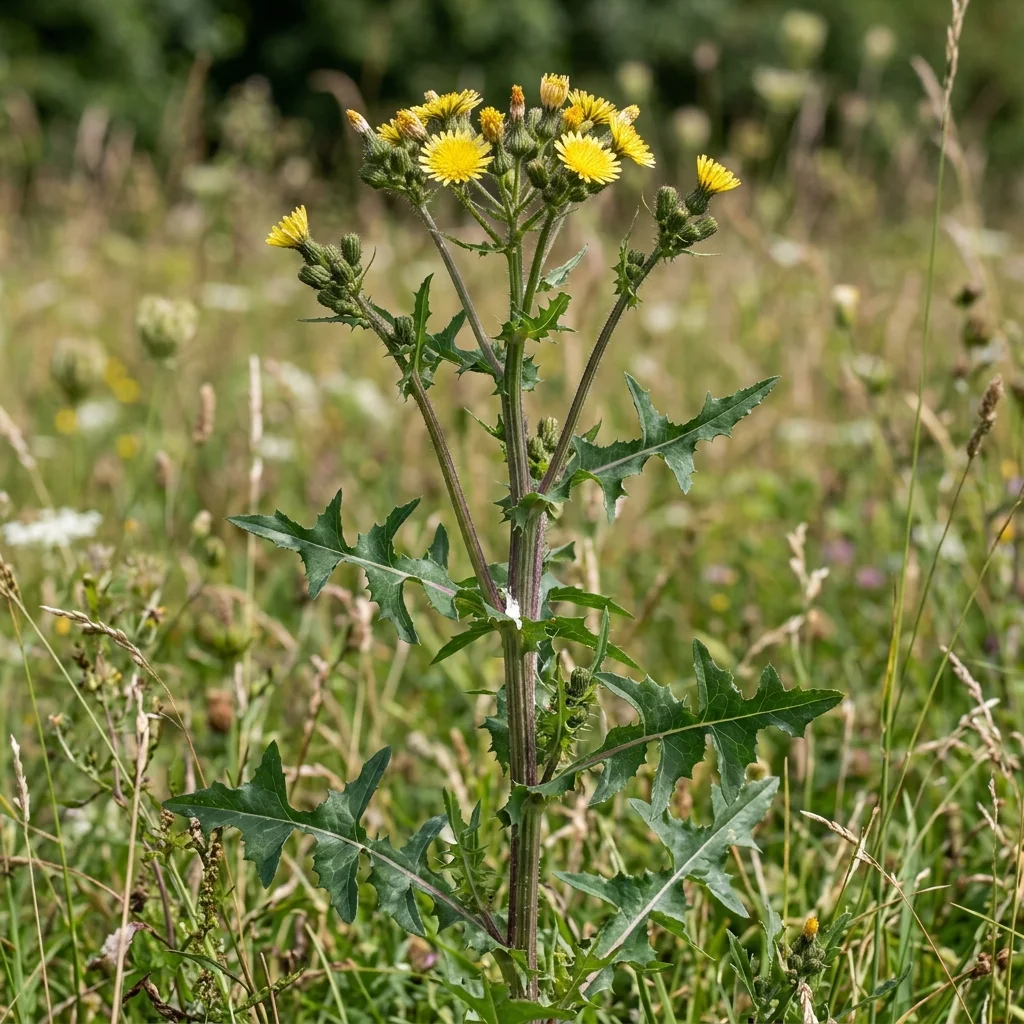
Common Sowthistle, also widely known as Annual Sowthistle, Hare's Lettuce, or Milky Tassel, is an exceptionally aggressive, fast-growing summer annual broadleaf weed in the aster family. Native to Europe and Asia, it has successfully colonized gardens, crop fields, and lawns globally. It features hollow, upright stems that bleed a thick white sticky sap when cut, deeply lobed dandelion-like leaves, and clusters of small, pale-yellow flower heads that mature into fluffy white wind-dispersed seedheads.





How to Identify Common Sowthistle
An upright annual with hollow stems bleeding milky white sap, deeply lobed opposite leaves clasping the stem, and clusters of yellow flowers.
-
✔
Milky White Sap: Hollow green-purple stems are succulent and immediately bleed a thick, sticky, bitter white latex when cut or bruised.
-
✔
Clasping Lobed Leaves: Soft, blue-green leaves are deeply lobed with pointed tips, showing pointed 'ears' (auricles) that clasp tightly around the stem.
-
✔
Fluffy White Seedballs: Pale-yellow flower heads bloom in clusters, maturing into round, fluffy white seedballs resembling small dandelions.
Complete Care & Management Guide
Access highly technical, scientific management directives to control or cultivate Common Sowthistle effectively.
Common Diseases & Treatment
Milky Latex Staining
Symptoms: Cutting the hollow stems bleeds a sticky white sap, causing sticky dark stains on hands and pruning shears.
Wind Seed Dispersal
Symptoms: Small yellow flowers mature into round, fluffy white seedballs, releasing seeds carried by autumn wind.
Frequently Asked Questions
How is Sowthistle different from Wild Lettuce?
Sowthistle (Sonchus oleraceus) has completely smooth, non-spiny leaf undersides, and leaf bases with pointed auricles that wrap around the stem. Wild Lettuce (Lactuca serriola) has a highly distinct, rigid row of sharp spines underneath the leaf central vein.
Why is it called 'Sowthistle'?
It is named 'Sowthistle' because historically, domestic female pigs (sows) were observed to feed exceptionally greedily on the succulent, milky-sap-filled leaves, and the plant was cultivated in parts of Europe as a nutritious livestock forage.
Are the leaves edible for humans?
Yes. Young, tender spring leaves are edible raw or cooked, tasting somewhat like bitter dandelion greens. They are widely harvested in Greece and New Zealand (known as Puha) as a highly nutritious green packed with vitamins.
What is the best way to get rid of it?
Because it has a shallow, weak taproot, it is very easy to pull out by hand, especially when the soil is wet. Hand-pull young rosettes in early summer before they develop their branched, hollow flower stalks.