Creeping Woodsorrel Identification & Control
Creeping Woodsorrel is an exceptionally aggressive, low-growing perennial broadleaf weed in the oxalis family. Native to southern Asia, it has successfully invaded home lawns, greenhouse beds, and ornamental borders globally. Unlike upright woodsorrel, it spreads aggressively via prostrate, creeping horizontal runners (stolons) that root at every node, forming dense purple-green mats. Sprouting three-part heart-shaped leaves and small yellow flowers, it is extremely difficult to eradicate once it anchors into turf grass.





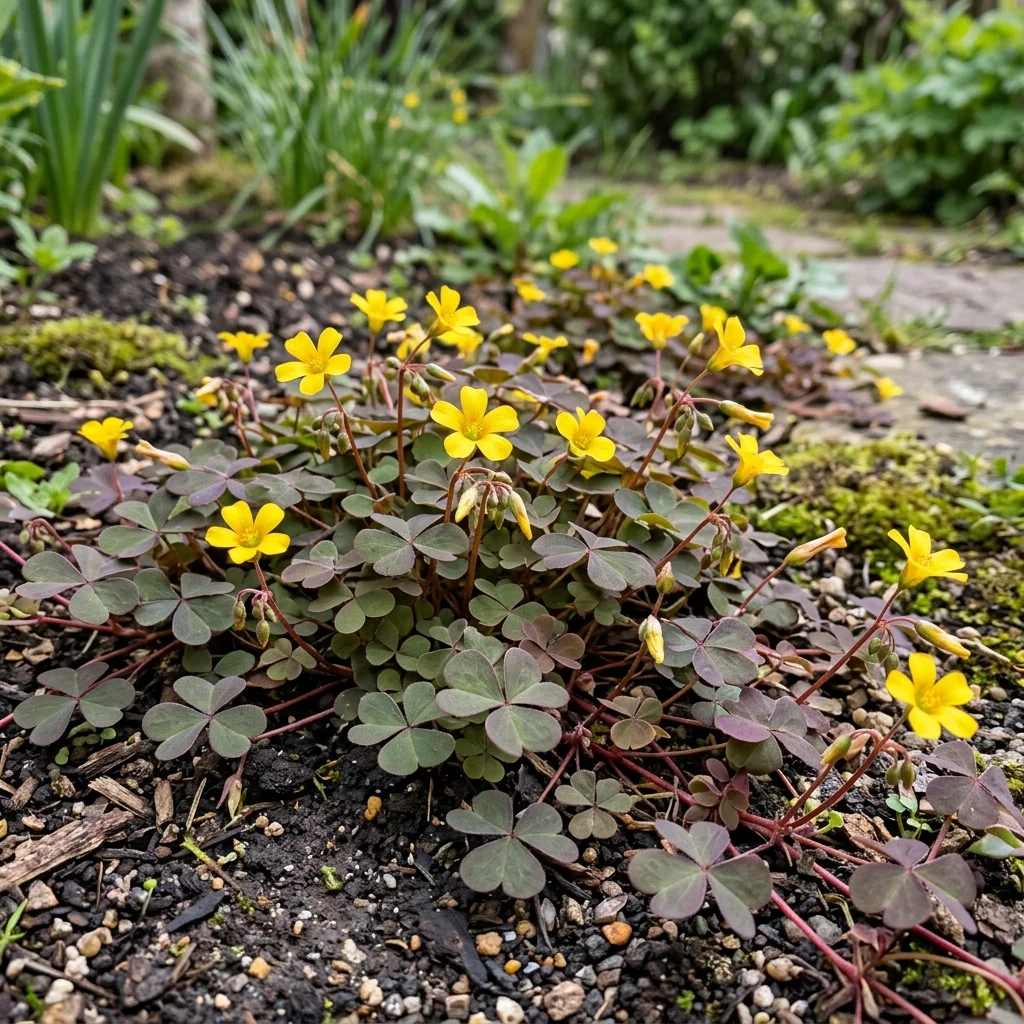
How to Identify Creeping Woodsorrel
A prostrate, creeping perennial weed forming dense purple-green mats, with heart-shaped leaflets, rooting stolon stems, and yellow flowers.
-
✔
Purple-Green Stolon Runners: Stems creep horizontally flat along the soil, frequently colored a deep reddish-purple, rooting firmly at every leaf node.
-
✔
Heart-Shaped Purple-Green Leaves: The three heart-shaped leaflets are often tinged with a beautiful, deep bronze-purple to reddish-brown color.
-
✔
Small Yellow Flowers: Dainty, small, bright yellow, 5-petaled flowers blooming individually or in pairs from upper leaf joints.
Complete Care & Management Guide
Access highly technical, scientific management directives to control or cultivate Creeping Woodsorrel effectively.
Common Diseases & Treatment
Stolon Node Rooting
Symptoms: The creeping square stems root at every node, making hand-pulling break the vine, leaving roots behind.
Explosive Seed Dispersal
Symptoms: Stiff, pointed seed capsules burst violently upon light touch, flinging seeds up to 10 feet.
Frequently Asked Questions
How do you distinguish Creeping Woodsorrel from Yellow Woodsorrel?
Creeping Woodsorrel (Oxalis corniculata) crawls flat along the ground, has horizontal runners that root at nodes, and leaves are often a deep bronze-purple. Yellow Woodsorrel (Oxalis stricta) grows strictly upright, lacks rooting stolons, and has light-green leaves.
Are the purple-green leaves toxic to pets?
Yes. Like all Oxalis species, it is rich in soluble calcium oxalates, which can cause salivation, tremors, weakness, and potential kidney failure in dogs, cats, and rabbits if ingested.
Why does it thrive in greenhouse pots?
The warm, damp, and shaded microclimate of greenhouse pots is perfect for this weed. It roots firmly in the rich potting soil, and its explosive seed pods easily shoot seeds into neighboring pots, making containment difficult.
What is the best way to get rid of it?
Because it roots at every node, hand-pulling must be done slowly to extract the entire creeping chain. Cardboard sheet mulching for a full year is also effective in garden beds.