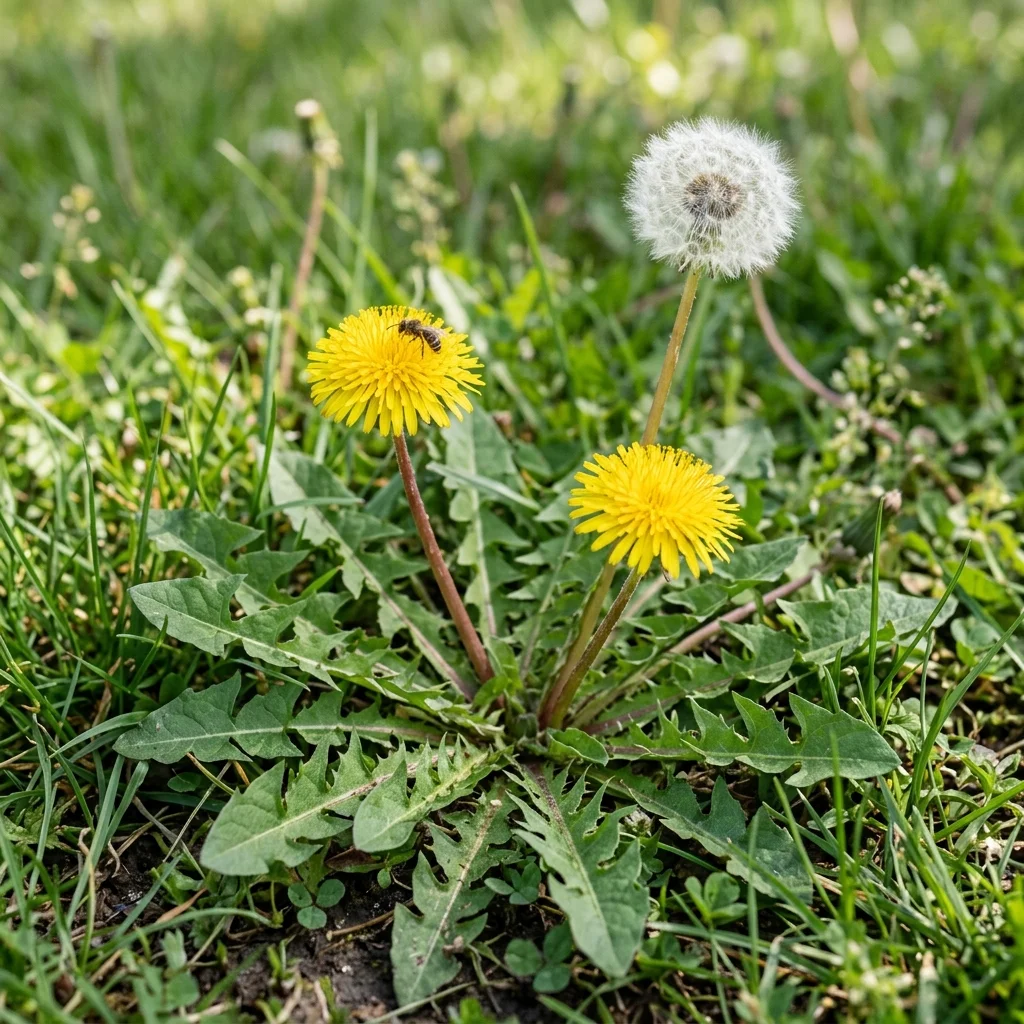
Taraxacum officinale

Dandelion Identification & Control

Dandelion is one of the most resilient, widely distributed, and aggressive broadleaf perennial weeds in the world. Native to Eurasia but thoroughly naturalized across North America and globally, it thrives vigorously in grassy lawns, fertile pastures, and disturbed soils. Highly celebrated for its deep, fleshy taproot that locks stubbornly into sub-soils, it sprouts brilliant golden-yellow flower heads that mature into delicate white puffballs of wind-dispersed seeds, posing a constant challenge to turf management.


Sunlight Icon
Sunlight Full Sun
Watering Icon
Watering Tolerance Low to Moderate
Soil Mix Icon
Soil Adaptability Any Soil / Clay
Temperature Icon
Growth Temp 5°C - 35°C
Toxicity Danger Icon
Danger / Toxicity Pet Safe / Edible
Botanical macro photography of Dandelion (Taraxacum officinale) - Plant AI care and control database

How to Identify Dandelion

A stemless perennial rosette with deeply lobed, tooth-like green leaves, a single hollow flower stalk bleeding milky sap, and a bright yellow flower head.

  • Lobed Toothed Leaves: Leaves are 5 to 25 cm, lance-shaped, deeply lobed with downward-pointing jagged teeth, arranged in a tight basal rosette.
  • Hollow Milky Stalk: A single, upright, smooth hollow green-red stalk that bleeds a sticky white latex or milky sap when cut.
  • Brilliant Yellow Head: A single terminal flower head composed of hundreds of golden-yellow ray florets, opening in sun and closing in dark.
💡 Plant AI Tip: Dandelion taproots can reach up to 3 feet deep! To eradicate mechanically, you must excavate the entire taproot. Any root fragment left behind will regenerate a brand new rosette.

Complete Care & Management Guide

Access highly technical, scientific management directives to control or cultivate Dandelion effectively.

Dandelions are extremely drought-tolerant due to their deep taproots. They thrive in damp spring lawns but survive dry summer baking by storing extensive water in their fleshy roots. Reducing watering will not control them.
Dandelions quickly adapt to mowing. Regular lawn mowing will cut off flower heads, but the basal rosette lies extremely flat to the soil, easily escaping the mower blades. Hand-pulling rosette clusters is recommended.
Highly adaptable to poor, nitrogen-deficient soils. They actively tap deep calcium and mineral deposits, bringing nutrients to the surface. Fertilizing lawn grasses actually helps choke out dandelions.
Requires Full Sun to thrive. They struggle under dense, tall grass canopies and complete shade. Utilizing lawn-dense grass shading is a highly effective organic control method.
Adapts to virtually all substrates, preferring clay, compacted turf soils, and alkaline lawns. Compacted soil prevents grass roots from expanding but dandelions easily drill through it.
Reproduces aggressively via seeds. The yellow flower matures into a white seedball (clock) of hundreds of parachute-like achenes carried miles by light wind drafts.
Extremely cold-hardy. The foliage shrivels under severe frosts, but the taproot survives freezing winter temperatures easily, sprouting fresh green rosettes in very early spring.
Features an exceptionally deep, thick, vertical fleshy taproot. Root extraction requires a specialized weeding fork or deep digging knife to pull the root intact without snapping.
Occasionally targeted by aphids and snout beetles, though pests rarely cause structural damage. Dandelions frequently serve as reservoir hosts for garden pests.
Highly prone to **Powdery Mildew** (white powdery film on leaves) and **Dandelion Rust** (orange pustules). *Action*: Crop leaves to reduce spore spread, or spray organic copper fungicide.
To achieve a dandelion-free lawn organically, maintain a tall (3+ inches) and dense grass canopy to shade out emerging seedlings, and excavate mature dandelions deep in spring before seedhead formation.

Are your Dandelions spreading rapidly or showing white leaf powder?

Excavate the deep taproot completely, check for wind-dispersed white seedballs, and monitor for powdery mildew.

Diagnose Weed Instantly

Common Diseases & Treatment

Powdery Mildew

Symptoms: Symptoms: A fuzzy, flour-like white coating covering the jagged green leaves, causing them to dry.

Action: Action: Crop and destroy affected foliage. Ensure proper lawn aeration to reduce humidity, and avoid overhead watering on turf margins.

Taproot Snapping

Symptoms: Symptoms: The dandelion rosette is pulled off, but the root snaps, leaving a white-bleeding root tip in the soil.

Action: Action: Regeneration alert! Snapped roots will grow back in 14 days. Use a deep-weeder tool to dig 4 inches down and remove the remaining root core.

Frequently Asked Questions

Why are Dandelions so difficult to pull out?

Dandelions feature a long, thick, vertical taproot that drills up to 2-3 feet deep into the soil and clings tightly to soil particles. Snapping the root during extraction triggers a regenerative response, where the remaining root piece grows fresh rosettes.

Are Dandelions toxic to pets?

No. Dandelions are completely safe and non-toxic to dogs, cats, and humans. In fact, the entire plant is highly edible, packed with vitamins A, C, K, iron, and calcium, often harvested for salads and teas.

How do Dandelion seeds disperse?

After flowering, the yellow head matures into a white puffball called a 'pappus.' Each seed is attached to a tiny, parachute-like structure of fine white hairs that allows it to float on wind drafts for miles.

What is the best way to prevent Dandelions organically?

The absolute best defense is a thick, dense, and tall lawn. Mow your grass high (3 inches or more) to block sunlight from reaching the soil, preventing dormant dandelion seeds from receiving the light they need to germinate.

No more dying plants. Grow healthy greens today!

Get Started for Free