Dollarweed Identification & Control
Dollarweed, also known as Pennywort or Marsh Pennywort, is an exceptionally aggressive, perennial broadleaf weed native to North America. Thriving in wet, swampy, and waterlogged soils, it is a major headache for home lawns and golf courses. It features highly unique, rounded, shield-shaped green leaves that resemble small green dollars, crawling aggressively via creeping rhizomes that form dense, interconnected mats.





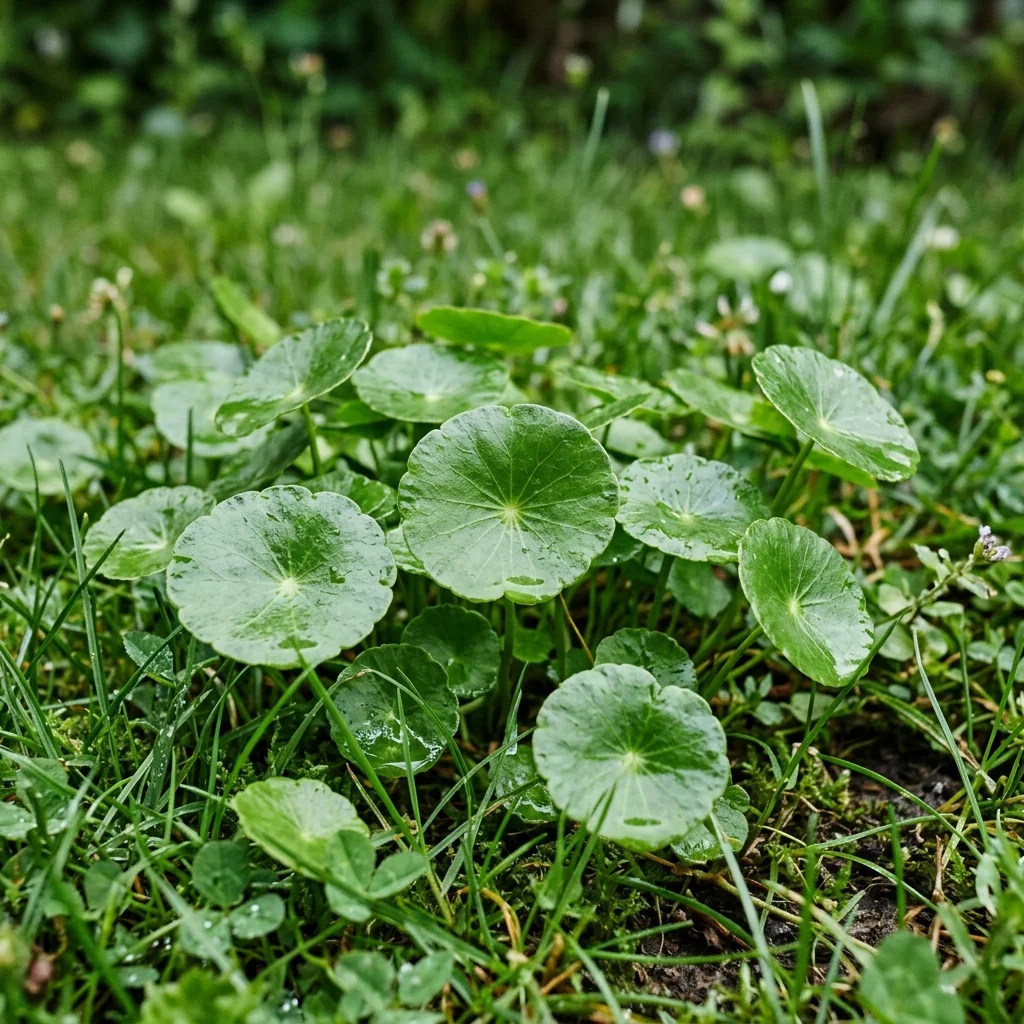
How to Identify Dollarweed
A creeping perennial with round, scalloped green leaves shaped like coins, with leaf stalks attached in the center of the leaf blade, and small green flowers.
-
✔
Silvery Round Leaves: Leaves are round, scalloped (3 to 5 cm wide), waxy-green, and look exactly like silver dollars.
-
✔
Central Stalk Attachment (Peltate): The leaf stalk is attached directly in the center of the leaf underside, like an umbrella.
-
✔
Creeping Stolon Stems: Slender green stems creep horizontally along the soil, rooting firmly at every leaf node.
Complete Care & Management Guide
Access highly technical, scientific management directives to control or cultivate Dollarweed effectively.
Common Diseases & Treatment
Leaf Spot
Symptoms: Water-soaked, circular black or dark brown spots with bright yellow halos appearing on the waxy green leaves.
Creeping Mat Invasion
Symptoms: The turf grass is completely replaced by dense, flat green mats of three-leaf clover.
Frequently Asked Questions
Why is it called Dollarweed?
It is named Dollarweed because its leaves are perfectly round, shiny green, and shaped like silver dollar coins, creating a distinct look when it grows in lawns.
How do you distinguish Dollarweed from Dichondra?
Dollarweed leaves are peltate, meaning the leaf stem connects directly to the center of the leaf undersides. Dichondra leaves are heart-shaped or kidney-shaped, and the leaf stem connects to the edge of the leaf margin.
Is Dollarweed toxic to pets?
No, Dollarweed is completely non-toxic and safe for dogs and cats. However, it can harbor ticks and fleas, and its presence indicates severe soil issues that should be addressed.
What is the best way to get rid of Dollarweed organically?
First, fix your lawn's drainage. Dollarweed cannot compete in dry soils. Core-aerate and top-dress with sand to improve infiltration, and hand-pull the creeping stolons.