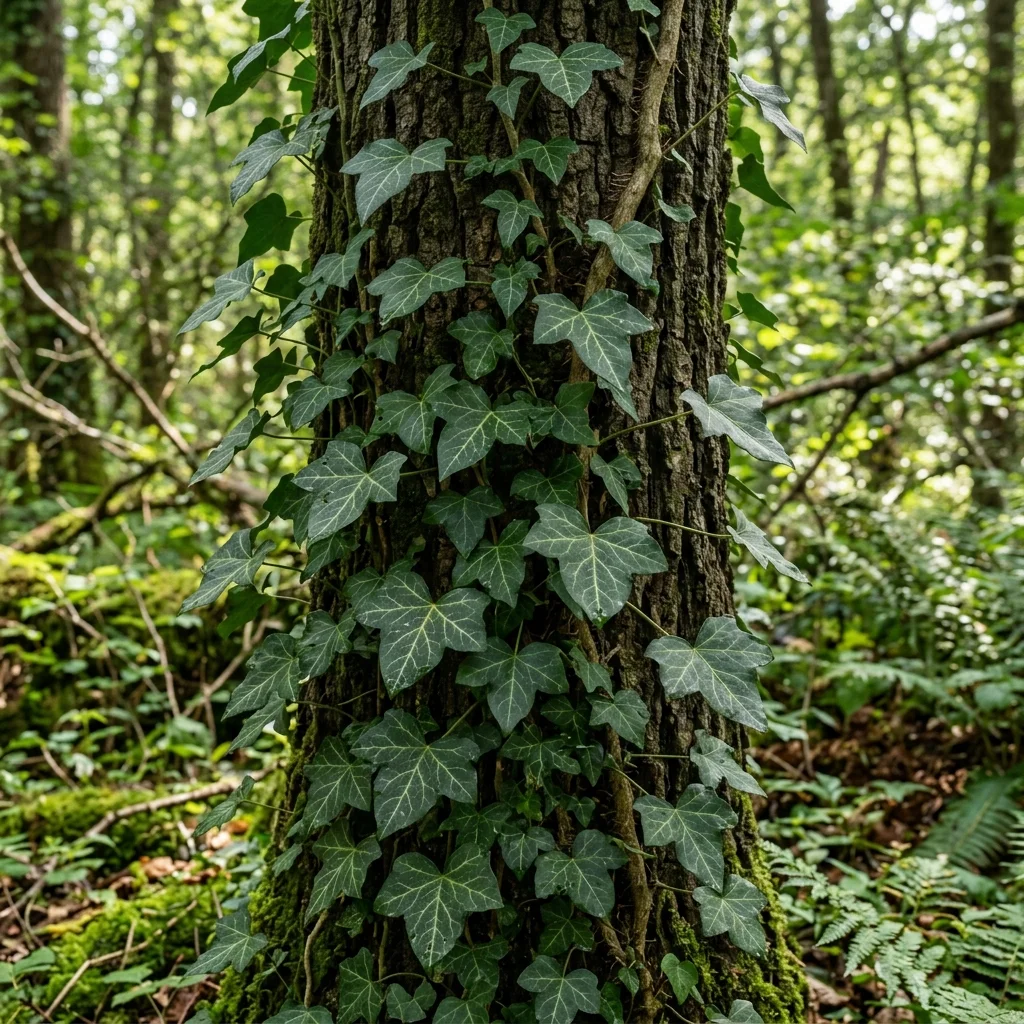
Hedera helix

English Ivy Identification & Control

English Ivy is an exceptionally aggressive, woody perennial climbing evergreen vine. Native to Europe and western Asia, it has been widely planted as an ornamental ground cover but has escaped to become a highly destructive forest invader. Spreading flat along forest floors, it forms dense 'ivy deserts' that choke out native wildflowers. Utilizing powerful clinging rootlets that secrete superglue-like substances, it climbs mature trees, strangling their bark, blocking sunlight from their leaves, and adding thousands of pounds of weight that easily collapses trees in winter storms.


Sunlight Icon
Sunlight Deep Shade to Full Sun
Watering Icon
Watering Tolerance Low to Moderate
Soil Mix Icon
Soil Adaptability Any Soil / Loam / Moist Clay
Temperature Icon
Growth Temp 2°C - 38°C
Toxicity Danger Icon
Danger / Toxicity Pet Toxic / Tree Suffocator
Botanical macro photography of English Ivy (Hedera helix) - Plant AI care and control database

How to Identify English Ivy

An evergreen climbing woody vine with dark-green, waxy leaves showing pale veins, rootlets along the stems, and small blue-black toxic berries.

  • Waxy Pale-Veined Leaves: Thick, waxy, evergreen leaves that are 3 to 5 lobed in juvenile stage, showing highly distinct, pale green-white veins.
  • Clinging Woody Vines: Woody stems are covered in thousands of tiny, sticky aerial rootlets that anchor the vine stubbornly to tree bark and brick walls.
  • Blue-Black Toxic Berries: Sprouts small, round, blue-black berries in late winter, which are toxic to humans and pets but eaten by birds.
⚠️ Tree Care Warning: When English Ivy climbs a tree, never try to rip the vines off the bark! The sticky rootlets cling so tightly that ripping the vine will tear off the tree's bark, exposing it to deadly pests. Instead, perform a 'girdle cut' at the base of the tree.

Complete Care & Management Guide

Access highly technical, scientific management directives to control or cultivate English Ivy effectively.

Extremely drought-tolerant once established due to its waxy leaves that resist moisture loss. It thrives in damp woodland shade but survives dry summers easily.
Resistant to standard pruning. While mowing keeps it flat on lawns, it will continue to spread horizontally, creeping under fences and climbing borders.
Highly adaptable to poor soils. It aggressively extracts moisture and nitrogen, leaving neighboring ornamental plants starved and stunted.
The ultimate shade specialist. Thrives in deep shade where turf grass completely fails. It easily climbs trees and structures to capture sunlight.
Adapts to clay, rich loam, sandy loam, and gravelly orchard beds, provided the substrate remains slightly moist. It does not require loose soil.
Spreads aggressively by creeping vines and seeds. Birds eat the toxic blue-black berries and deposit the seeds along fence lines and trees.
Extremely cold-hardy evergreen perennial. The waxy green foliage survives freezing winter temperatures easily, staying green all winter.
Features a shallow but extremely dense, tough fibrous root network anchored to creeping stolons that root at every node touching the soil.
Occasionally targeted by spider mites and scale insects, though pests rarely cause significant damage to its highly robust creeping network.
Subject to **Bacterial Leaf Spot** under humid conditions, which causes circular black spots on the waxy leaves.
To save trees from English Ivy organically, perform a 'girdle cut'. Use pruners to cut a 2-foot section of all ivy vines around the tree trunk at chest height. The upper vines will die and wither naturally.

Are your trees or brick walls covered in thick, waxy evergreen vines?

Perform girdle cuts at chest height to starve climbing vines, dig out shallow fibrous roots, and check for pale leaf veins.

Diagnose Weed Instantly

Common Diseases & Treatment

Bacterial Leaf Spot

Symptoms: Symptoms: Water-soaked, circular black or dark brown spots with bright yellow halos appearing on the waxy green leaves.

Action: Action: Clip and dispose of infected foliage. Avoid overhead watering to keep leaf surfaces dry, and ensure proper air circulation.

Tree Canopy Smothering

Symptoms: Symptoms: Ivy climbs to the very top of a tree, completely covering branches and blocking sunlight from the tree's leaves.

Action: Action: Girdle cut. Cut a 12-inch gap in all ivy vines around the tree trunk. The upper ivy will die on the tree. Dig up the lower roots.

Frequently Asked Questions

Why is English Ivy considered an ecological weed?

When English Ivy grows as a ground cover in forests, it forms a dense, evergreen blanket that blocks sunlight and moisture, completely choking out native wildflowers and young tree seedlings. It also climbs and kills mature trees.

Is English Ivy toxic to pets?

Yes. English Ivy contains triterpenoid saponins (hederagenin) in its leaves and berries. If chewed by dogs, cats, or horses, it can cause severe salivation, vomiting, diarrhea, and abdominal pain.

How does the 'girdle cut' work?

To kill climbing ivy on a tree, use shears to cut all ivy stems completely around the tree trunk in a 1-foot band. The ivy roots in the soil will no longer be connected to the upper vine, causing the upper section to die, dry out, and crumble without damaging the tree's bark.

What is the best way to eradicate English Ivy ground cover?

Mow the ivy patch close to the ground, then cover it with a layer of overlapping cardboard, and add 4 inches of wood chips. Leave this in place for a full year to suffocate the root system, and pull any shoots immediately.

No more dying plants. Grow healthy greens today!

Get Started for Free