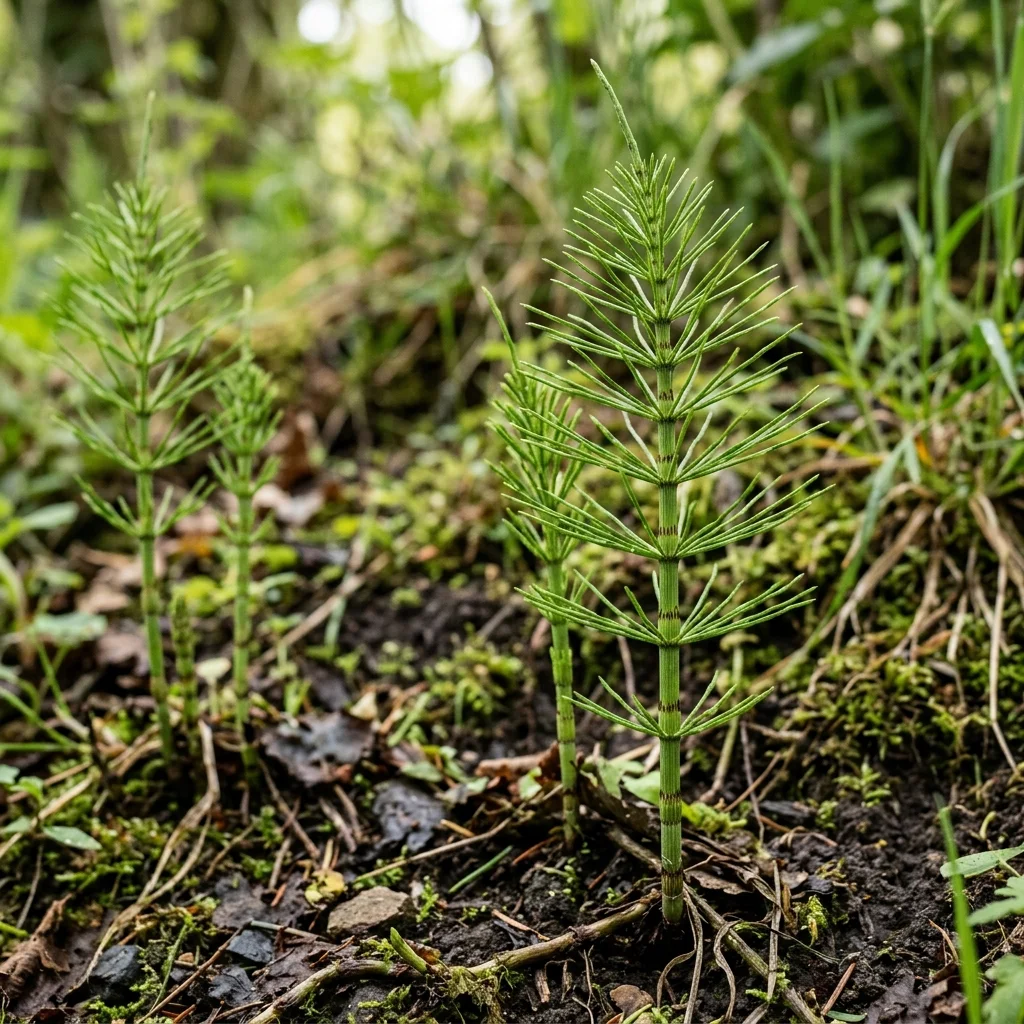
Equisetum arvense

Field Horsetail Identification & Control

Field Horsetail, botanically known as Equisetum arvense, is an exceptionally ancient, non-flowering perennial weed in the Equisetaceae family. Residing on Earth since the Devonian era, it is a persistent nuisance in home gardens, crop fields, and damp pasture land. It features two distinct stem types: sterile, highly branched green vegetative stems that resemble miniature pine trees, and early-spring fertile brown stems that bear spore-producing cones. Packed with highly abrasive silica crystals, it is notoriously difficult to eradicate due to a sprawling network of black underground rhizomes that drill up to 6 feet deep. Fresh plants contain thiaminase, which breaks down vitamin B1, posing a severe toxicity hazard to grazing horses.


Sunlight Icon
Sunlight Full Sun to Partial Shade
Watering Icon
Watering Tolerance Moderate to High
Soil Mix Icon
Soil Adaptability Damp Sand / Poor Compacted Clay / Wet Soil
Temperature Icon
Growth Temp 5°C - 30°C
Toxicity Danger Icon
Danger / Toxicity Toxic to Horses / Rich in Abrasive Silica
Botanical macro photography of Field Horsetail (Equisetum arvense) - Plant AI care and control database

How to Identify Field Horsetail

An ancient spore-bearing perennial with jointed green pine-like vegetative stems and early spring fleshy brown spore cones, bleeding zero sap.

  • Jointed Ribbed Stems: Upright green vegetative stems (up to 2 feet tall) are deeply ribbed, hollow, jointed, and feel highly rough and abrasive to the touch.
  • Whorled Needle Leaves: Branches radiate from the stem joints in highly distinct, elegant, green needle-like whorled patterns.
  • Early Spring Spore Cones: Fleshy, unbranched, brownish-tan fertile stems emerge in early spring, bearing a single pinecone-like spore cone (strobilus) at the tip.
💡 Ancient Survivor: Field Horsetail has been growing for over 300 million years! Its cell walls are packed with crystalline **silica**, historically used by pioneers to scrub metal pots, earning it the common nickname 'scouring rush'.

Complete Care & Management Guide

Access highly technical, scientific management directives to control or cultivate Field Horsetail effectively.

Thrives in consistently wet, saturated, and poorly drained soils. It is highly adapted to waterlogged garden edges but can survive dry seasons by tapping deep underground moisture channels.
Resistant to mowing. Mower blades easily cut the soft vegetative stems, but the plant quickly shoots up new branches from its deep underground creeping nodes.
An indicator of low-oxygen, acidic, and nutrient-deficient soils. Shifting soil pH to more alkaline by adding lime and improving drainage is highly effective in weakening it.
Thrives in Full Sun but exhibits high tolerance to Partial Shade, easily dominating orchard floors, damp ditch banks, and low shaded garden borders.
Prefers damp acidic sand, compacted heavy clay, and gravelly driveways. It easily grows through cracks in asphalt and concrete slabs.
Does not produce flowers or seeds! It reproduces strictly via wind-blown microscopic spores released from spring cones, and aggressively via creeping rhizomes.
Extremely cold-hardy perennial. The above-ground green stems die back completely with the first hard autumn frost, but the underground black rhizomes survive easily.
Features an exceptionally deep, sprawling network of creeping black underground rhizomes that can reach 6 feet deep, making mechanical extraction extremely challenging.
Virtually immune to pests. The high silica content and thick cuticular structure act as an outstanding natural deterrent to herbivorous insects.
Highly disease-resistant. It rarely suffers any structural damage from common garden fungi, maintaining vigorous growth throughout the season.
To control Field Horsetail organically, improve soil drainage, apply agricultural lime to raise soil pH, and repeatedly cut the green stems to starve the rhizomes.

Are your damp pathways showing jointed pine-like green stems or brown spring cones?

Improve clay soil drainage, cut vegetative stems flat repeatedly to exhaust rhizomes, and keep horses away.

Diagnose Weed Instantly

Common Diseases & Treatment

Equine Thiamine Deficiency

Symptoms: Symptoms: Grazing horses consume fresh horsetail, leading to vitamin B1 breakdown, severe muscle weakness, loss of coordination, and paralysis.

Action: Action: Immediate veterinary intervention! Stop horsetail grazing, and administer therapeutic doses of thiamine (vitamin B1) intravenously.

Asphalt Pavement Breakthrough

Symptoms: Symptoms: Stems drill through asphalt driveways and concrete block seams, causing physical buckling and structural cracking.

Action: Action: Dig up the asphalt seam, extract the deep creeping black rhizomes, and pack the seam with agricultural lime before resealing.

Frequently Asked Questions

Why is it called 'Field Horsetail'?

The name Field Horsetail comes from its highly characteristic green vegetative stage, where the jointed stems and delicate whorled needle branches resemble a fluffy green horse's tail.

Is Field Horsetail really toxic to livestock?

Yes. It contains the enzyme thiaminase, which actively breaks down thiamine (vitamin B1). When ingested by horses in fresh pastures or dried hay over several weeks, it causes severe vitamin B1 deficiency, leading to loss of coordination and muscle weakness.

What is the best way to get rid of it?

Because its creeping black rhizomes sprout vigorously from broken segments, hand-pulling is rarely effective alone. You must improve soil aeration, raise soil pH by adding lime, and repeatedly cut the fronds to starve the rhizomes.

Why does it feel so abrasive and rough?

The epidermal cell walls of Field Horsetail actively absorb mineral silica from the soil, forming hard, abrasive crystals on the stem surface. Historically, this made the weed a favorite scouring brush for cleaning metal cookware.

No more dying plants. Grow healthy greens today!

Get Started for Free