Horsenettle Identification & Control
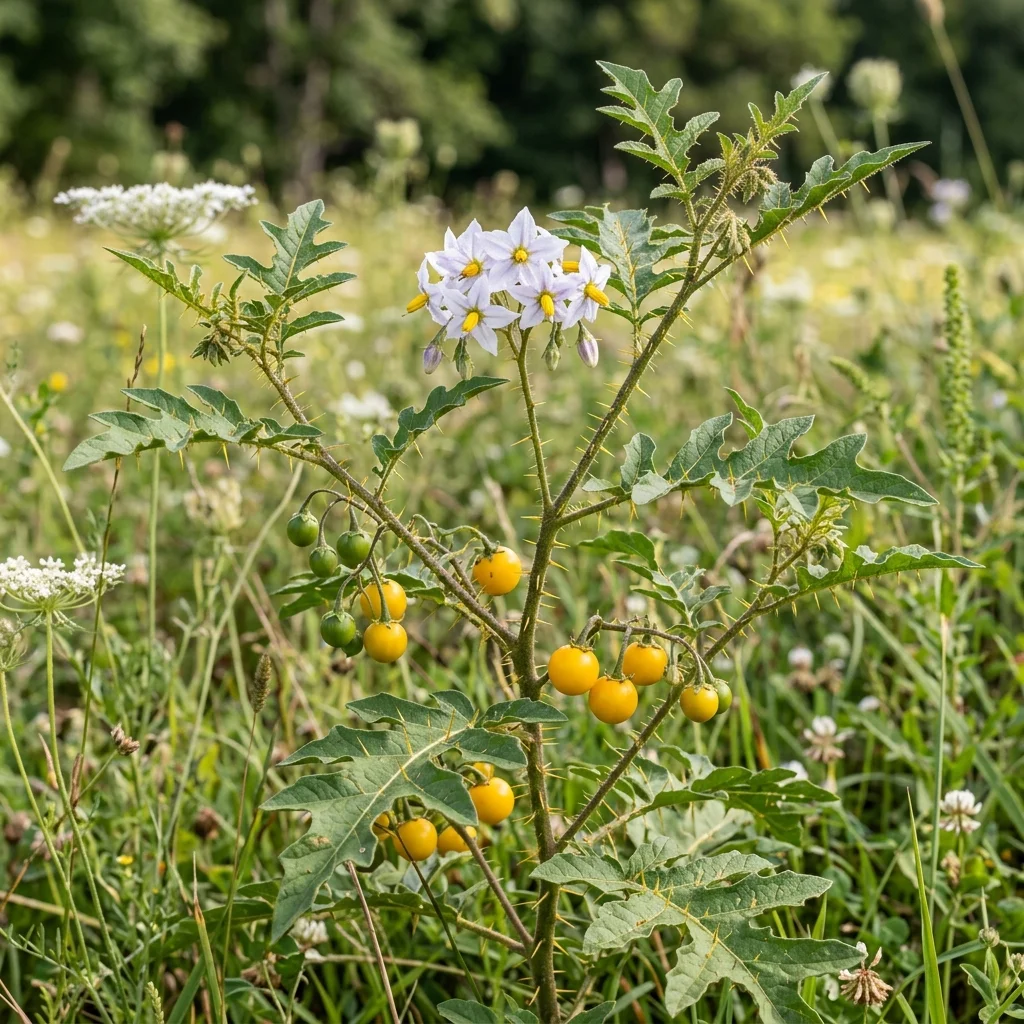
Carolina Horsenettle, botanically known as Solanum carolinense, is an exceptionally aggressive, highly toxic perennial broadleaf weed in the nightshade family. Native to the southeastern United States, it is a dreaded weed in crop fields and pastures globally. The stems and leaf veins are covered in sharp, yellowish spines, and it spreads aggressively via creeping underground rhizomes. It produces star-shaped purple-white flowers and small, tomato-like yellow berries packed with toxic solanine.





How to Identify Horsenettle
An upright perennial with yellow spines along stems and leaf veins, star-shaped purple-white flowers, and yellow tomato-like berries.
-
✔
Sharp Yellow Spines: Upright stems and the undersides of leaf veins are heavily armed with sharp, needle-like, yellowish spines.
-
✔
Tomato-Like Yellow Berries: Small, round berries (1.5 cm wide) that are green with marbled stripes when young, maturing to dry, yellow-orange wrinkly globes.
-
✔
Star-Shaped Purple Flowers: Clusters of 5-petaled white-to-pale-violet flowers with a highly distinct, prominent cone of bright yellow stamens.
Complete Care & Management Guide
Access highly technical, scientific management directives to control or cultivate Horsenettle effectively.
Common Diseases & Treatment
Solanine Toxicity Poisoning
Symptoms: Ingestion of yellow berries by horses or cattle leads to drooling, colic, dilated pupils, paralysis, and liver failure.
Spiny Stem Puncture
Symptoms: Hand-pulling without gloves causes immediate pain, puncture wounds, and localized skin swelling from the yellow spines.
Frequently Asked Questions
Why is Horsenettle so hard to eradicate?
Horsenettle features an exceptionally deep, thick, vertical taproot anchored to a massive network of creeping horizontal rhizomes. If you pull it and leave even a tiny piece of rhizome in the soil, it will regenerate into a new plant.
Are the yellow berries edible?
Absolutely not! The berries look exactly like small yellow cherry tomatoes (giving it the nickname sand brier), but they are highly toxic, packed with deadly solanine glycoalkaloids. Eating them can be fatal to pets and children.
Does it have any native host value?
Yes. Horsenettle is a host plant for the larvae of the tobacco hornworm (Manduca sexta) and the potato beetle. However, in lawns and pastures, it is a highly noxious weed that must be controlled.
What is the best way to get rid of it?
Wear thick leather gloves. Slice the central taproot 3 inches below the soil surface using a sharp spade while the plant is still small in late spring. Repeatedly clip new shoots to starve the deep creeping rhizomes.