Horsetail Identification & Control
Field Horsetail, also known as Mare's Tail or Scouring Rush, is an exceptionally ancient, persistent, and highly difficult-to-eradicate perennial weed. Sprouting from a lineage of prehistoric plants that dominated the earth 300 million years ago, it thrives in damp, poorly drained, and acidic soils. It is highly notorious for its dual lifecycle, producing fleshy, fertile brown cone-tipped stalks in early spring followed by sterile, green, brush-like stalks. Saturated with high levels of silica (sand), the hollow stems are extremely rough, and its creeping rhizomes can drill up to 6 feet deep, easily breaking upon pulling.





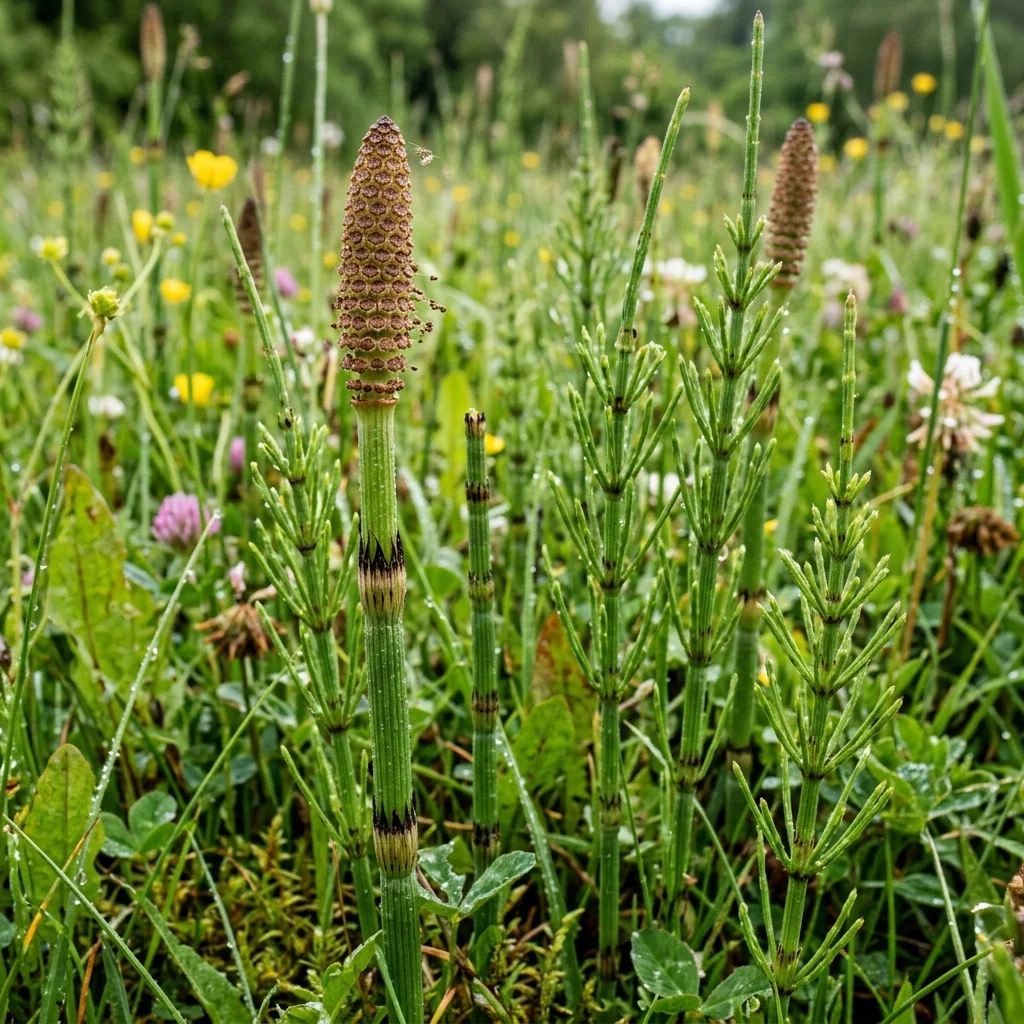
How to Identify Horsetail
A primitive spore-producing perennial with two distinct growth phases: early fleshy brown cone-tipped fertile stalks, and summer green brush-like hollow jointed stalks.
-
✔
Green Brush-Like Stalks: Sterile summer stems are green, hollow, highly jointed, with whorls of slender pine-needle-like branches at joints, resembling a horse's tail.
-
✔
Early Fertile Brown Stalks: Fleshy, unbranched brownish stalks (10 to 20 cm) sprout in early spring, tipped with a cone-like strobilus that releases millions of green spores.
-
✔
Rough Silica Stems: Stems contain high levels of cellular silica, making them feel extremely rough, dry, and sandpaper-like when rubbed.
Complete Care & Management Guide
Access highly technical, scientific management directives to control or cultivate Horsetail effectively.
Common Diseases & Treatment
Silica Frustration
Symptoms: Pulling the jointed green stems causes them to snap easily at joints, leaving the deep roots completely untouched.
Spore Release
Symptoms: Fleshy brown cone-tipped stalks sprout rapidly in early March, releasing clouds of green dust (spores).
Frequently Asked Questions
Does Horsetail produce seeds?
No. Horsetail is a primitive, vascular spore-producing plant. It belongs to an ancient family that predates flowering plants, reproducing instead via wind-dispersed green spores and underground rhizomes.
Why is it toxic to horses?
Horsetail contains thiaminase, an enzyme that actively destroys vitamin B1 (thiamine) in horses and cattle if consumed in hay. This leads to thiamine deficiency, muscle weakness, and coordination loss ('equine staggers').
Why is it so hard to kill with chemicals?
Its stems are covered in a highly protective, thick, waxy cuticle and saturated with silica, which prevents liquid chemical weed killers from absorbing. Manual cutting and soil sweetening (liming) are much more effective.
What is the best way to eradicate Horsetail organically?
First, raise the soil pH. Horsetail loves acidic soils; applying agricultural lime makes the soil unfavorable. Next, improve drainage to dry the area, and cut down the green brush stems weekly to exhaust the roots.