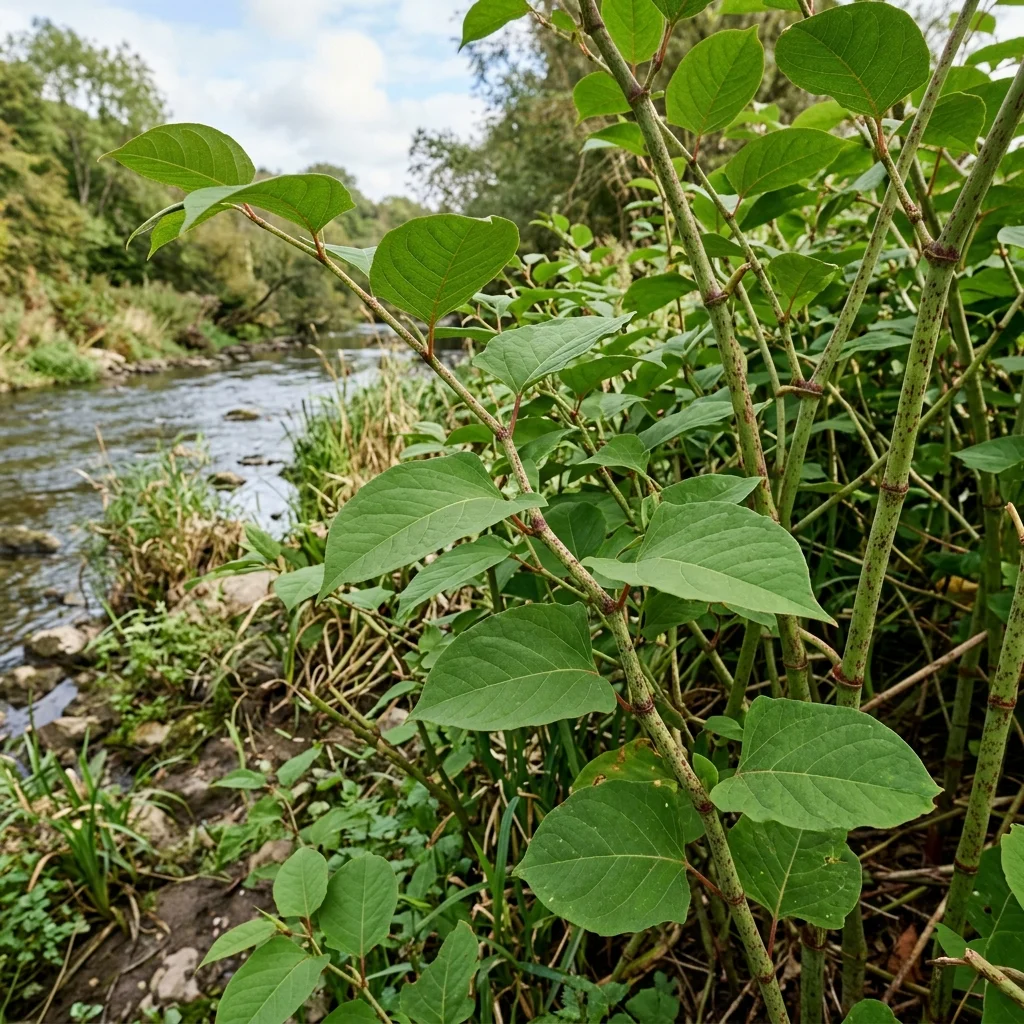
Reynoutria japonica

Japanese Knotweed Identification & Control

Japanese Knotweed is an exceptionally aggressive, destructive, and legally restricted perennial weed that stands as one of the world's worst invasive species. Native to East Asia, it was introduced to Europe and North America as an ornamental shield plant. It features hollow, bamboo-like green stems with reddish spots and large shield-shaped leaves. What makes this plant terrifying is its incredibly powerful rhizome root system, which can grow through concrete, crack home foundations, block drainage pipes, and severely devalue property values, requiring specialized professional eradication.


Sunlight Icon
Sunlight Full Sun to Shade
Watering Icon
Watering Tolerance Moderate to High
Soil Mix Icon
Soil Adaptability Any Soil / Clay / Disturbed Gravel
Temperature Icon
Growth Temp 5°C - 38°C
Toxicity Danger Icon
Danger / Toxicity Structural Damage / Home Foundations
Botanical macro photography of Japanese Knotweed (Reynoutria japonica) - Plant AI care and control database

How to Identify Japanese Knotweed

An erect, bamboo-like perennial forming dense thickets, with reddish-spotted hollow stems, large spade-shaped leaves, and lace-like upright white flowers.

  • Bamboo-Like Hollow Stems: Stems are strictly hollow, jointed, bright green with highly distinct reddish-purple speckles, growing rapidly up to 10 feet tall.
  • Spade-Shaped Leaves: Bright green, smooth, shield-shaped or spade-shaped leaves (10 to 15 cm long) with a completely flat, square base.
  • Upright Lacy White Flowers: Dainty, small, creamy-white flowers blooming in late summer in long, upright, lacy plumes at upper leaf joints.
⚠️ Legal & Foundation Alert: In many countries (like the UK), it is illegal to allow Japanese Knotweed to spread, and its presence can prevent you from getting a home mortgage! The roots can drill through 3 inches of solid concrete. Never try to dig it out carelessly as any tiny root piece will regrow.

Complete Care & Management Guide

Access highly technical, scientific management directives to control or cultivate Japanese Knotweed effectively.

Extremely resilient. It thrives in damp riparian riverbanks and low drainage areas, but survives intense drought by storing massive water and starch reserves in its thick woody rhizomes.
Highly resistant to pruning. Cutting or mowing the stems actually triggers a defensive survival response, forcing the underground rhizomes to expand horizontally and shoot up new canes.
Highly aggressive. It grows in dense, monolithic thickets that block 99% of sunlight, completely choking out all native flora and altering soil biology.
Highly versatile. Thrives in Full Sun but exhibits high shade tolerance, allowing it to colonize dense forest understories and dark house alleyways.
Adapts to clay, gravel, rocky soils, and cracked concrete seams, actively exploiting microscopic soil cracks to expand its roots.
Spreads almost entirely vegetative via creeping rhizomes. A tiny fragment of rhizome weighing just 0.7 grams can regenerate into a massive new colony.
Perennial. The hollow canes turn reddish-brown, die, and become brittle in winter, but the underground rhizomes survive deep freezing easily, sprouting in early spring.
Features an exceptionally deep, tough, scaly woody rhizome network that can drill 10 feet deep and spread 20 feet horizontally, anchoring tightly to sub-soils.
Occasionally targeted by the knotweed psyllid (*Aphalara itadori*), which has been introduced as a biological control agent, though natural pests rarely kill established patches.
Highly disease-resistant. It suffers virtually zero structural damage from natural plant diseases, maintaining highly aggressive growth.
Never dig or transport Japanese Knotweed soil. Eradication is best done by injecting a systemic herbicide (Glyphosate) directly into the hollow stems in late summer, or suffocating the clump with a heavy barrier for 5 years.

Is your backyard showing bamboo-like canes with red spots or foundation cracks?

Inject systemic herbicides directly into hollow stems, avoid tilling, and check for spade-shaped leaves.

Diagnose Weed Instantly

Common Diseases & Treatment

Foundation Crack Penetration

Symptoms: Symptoms: Scaly red-yellow rhizomes push actively through microscopic cracks in home concrete walls and asphalt.

Action: Action: Do not dig. Inject a professional-grade systemic herbicide directly into the adjacent hollow canes to kill the deep root source.

Canes Die-Back Thatch

Symptoms: Symptoms: Tall hollow stems turn brown, dry, and collapse in winter, forming a thick, rotting mulch barrier that blocks other seeds.

Action: Action: Carefully cut the dry canes at ground level and bag them securely. Never shred them or put them in compost as any node can sprout.

Frequently Asked Questions

Why is Japanese Knotweed considered such a severe real estate threat?

Its scaly rhizomes are incredibly strong and search for moisture in microscopic soil cracks. When they penetrate cracks under home foundations, retaining walls, or drainage pipes, the roots expand, cracking concrete, lifting driveways, and causing severe structural damage.

Why shouldn't I try to weed it manually?

Manual digging almost always fails because the root network is vast (10 ft deep, 20 ft wide) and highly brittle. Shoveling chops the roots, and any tiny root fragment weighing less than a gram left in the dirt will sprout a new plant.

Is Japanese Knotweed edible?

Yes! The young, tender spring shoots (under 8 inches tall) are edible and have a crisp texture with a sour, tart taste resembling rhubarb. They are rich in vitamin C and resveratrol. *WARNING*: Only harvest from areas guaranteed free from herbicides.

How do you kill Japanese Knotweed permanently?

The most effective method is stem injection. In late summer or autumn, cut the hollow canes about 6 inches above the soil, and inject a specialized systemic herbicide directly into the hollow core. The plant will carry the herbicide deep into the rhizome network, killing it from within.

No more dying plants. Grow healthy greens today!

Get Started for Free