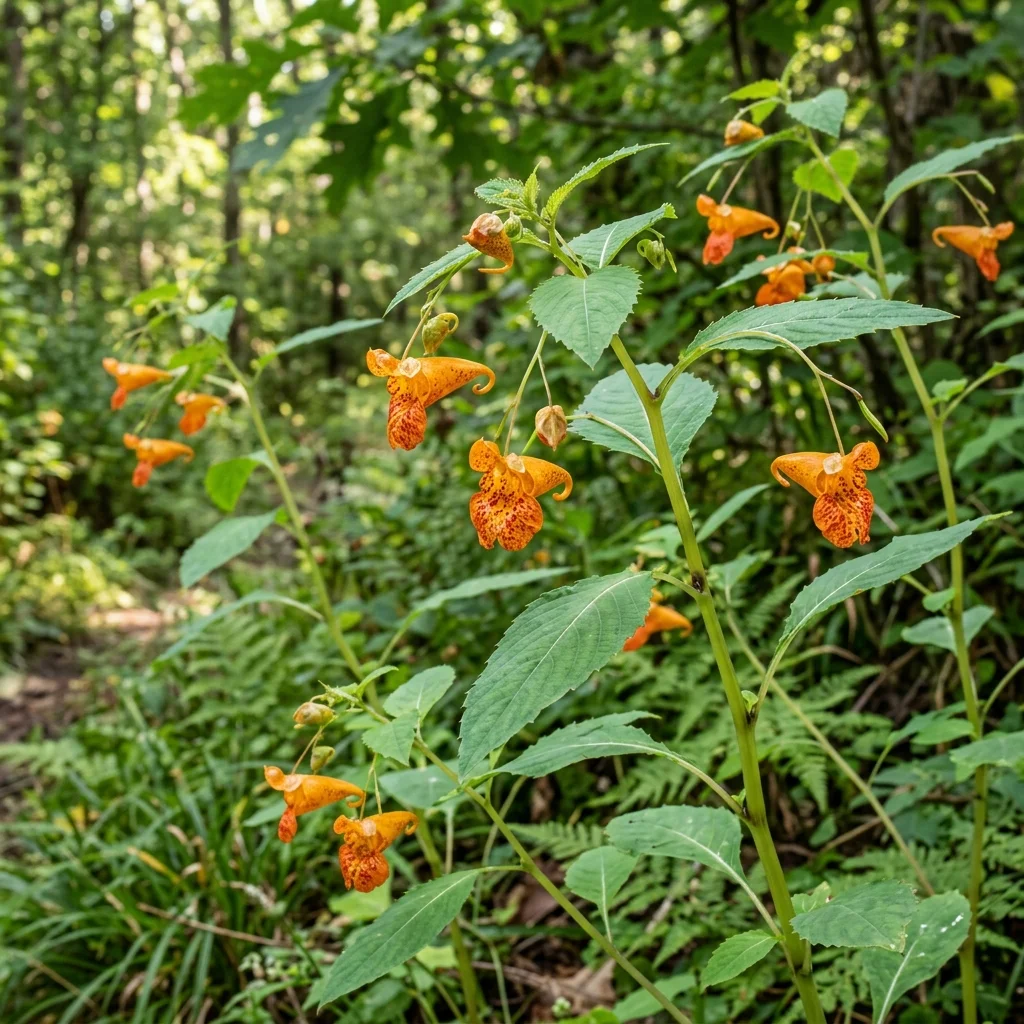
Impatiens capensis

Jewelweed Identification & Control

Jewelweed, also widely known as Spotted Touch-Me-Not, Orange Balsam, or Quick-in-the-Hand, is an exceptionally fast-growing annual broadleaf weed. Native to North America, it thrives abundantly in moist, shaded woodland borders, ditch margins, and riverbanks. It features translucent, succulent green-red stems and oval leaves, producing highly unique, orange trumpet-shaped flowers with reddish-brown spots, and explosive seedpods that burst violently upon touch.


Sunlight Icon
Sunlight Partial Shade to Deep Shade
Watering Icon
Watering Tolerance High
Soil Mix Icon
Soil Adaptability Wet Saturated / Rich / Forest Loam
Temperature Icon
Growth Temp 8°C - 30°C
Toxicity Danger Icon
Danger / Toxicity Pet Safe / Poison Ivy Remedy
Botanical macro photography of Jewelweed (Impatiens capensis) - Plant AI care and control database

How to Identify Jewelweed

An upright annual with translucent succulent stems, opposite green leaves, showy orange spotted trumpet flowers, and explosive seed capsules.

  • Orange Trumpet Flowers: Beautiful, showy, orange funnel-shaped flowers (up to 3 cm long) covered in reddish-brown spots, hanging like jewels.
  • Explosive Seed Capsules: Slender green seed pods that burst open violently upon the slightest touch, curling instantly to catapult seeds.
  • Translucent Succulent Stems: Stems are hollow, juicy, smooth, and highly translucent, often showing a bright green-red watery appearance.
💡 Plant AI Tip: Nature's Poison Ivy cure! Jewelweed juice contains **lawsone**, which actively dissolves and neutralizes the toxic **urushiol** oil of Poison Ivy. Rubbing crushed jewelweed stems on your skin instantly stops poison ivy itching.

Complete Care & Management Guide

Access highly technical, scientific management directives to control or cultivate Jewelweed effectively.

Requires consistent moisture. It thrives in damp, wet, poorly drained soils, riverbanks, and overwatered garden beds. Allowing the top soil layer to dry out helps slow its spread.
Resistant to mowing. Regular mowing will clip the tall stems and limit seed formation, but the plant will quickly shoot up new stems from its creeping yellow rhizomes.
Highly aggressive. It actively steals high levels of nitrogen and soil nutrients, severely stunting neighboring garden crops and turf grasses.
Highly shade-tolerant. It easily colonizes damp, shaded lawn areas beneath trees where competitive turf grasses like Kentucky Bluegrass struggle and thin out.
Prefers moist, rich, organic loam and nitrogen-rich damp soils. It struggles heavily in dry, barren, sandy soils with low organic matter.
Reproduces strictly by seeds. The seed pods explode when dry, flinging seeds up to 10 feet horizontally. A single plant can produce thousands of seeds.
A cool-season annual. It germinates in autumn or winter, grows rapidly in cool spring weather, and dies out quickly in hot, dry mid-summer temperatures.
Features an exceptionally shallow, delicate, fibrous root system. Due to shallow rooting, it is very easy to pull out by hand or scrape with a hoe.
Occasionally targeted by aphids, but pests rarely cause significant damage to this highly robust annual grass.
Highly disease-resistant. It suffers virtually zero structural damage from natural plant diseases, maintaining highly aggressive growth.
To control Jewelweed organically, hand-pull young rosettes in spring before they flower, use a hoe to scrape seedlings, and mulch garden beds heavily to block seed light.

Are your shaded yard corners showing orange spotted flowers or explosive seed capsules?

Hand-pull the shallow fibrous roots easily in spring, watch for explosive seedpods, and rub juice on poison ivy rash.

Diagnose Weed Instantly

Common Diseases & Treatment

Browning Leaf Spot

Symptoms: Symptoms: Water-soaked, circular black or dark brown spots with bright yellow halos appearing on the waxy green leaves.

Action: Action: Clip and dispose of infected foliage. Avoid overhead watering to keep leaf surfaces dry, and ensure proper air circulation.

Explosive Seed podting

Symptoms: Symptoms: Stiff, pointed seed capsules burst violently upon light touch, flinging seeds up to 10 feet.

Action: Action: Place a clear plastic bag over the seeded stems before cutting to catch the flying seeds, and dispose in trash bags.

Frequently Asked Questions

Why is it called 'Jewelweed' and 'Touch-Me-Not'?

It is named 'Jewelweed' because when the waxy leaves are held underwater, they trap a thin layer of air that sparkles like a silver jewel. 'Touch-Me-Not' refers to the seed capsules, which burst violently upon the slightest touch.

Does it really cure Poison Ivy rash?

Yes! Jewelweed contains lawsone, a natural compound that actively binds to skin proteins and dissolves the sticky, toxic urushiol oil of Poison Ivy and Poison Oak, preventing the severe rash from forming if applied quickly.

Is Jewelweed toxic to pets?

No, Jewelweed is completely non-toxic and safe for dogs and cats. In fact, it is a highly valued wild edible herb when harvested young and cooked.

What is the best way to get rid of it?

Because it has a shallow fibrous root system, it is very easy to pull out by hand. Manual weeding or close mowing in mid-summer before the flower stalks open is the most effective organic control method.

No more dying plants. Grow healthy greens today!

Get Started for Free