Rosa multiflora

Multiflora Rose Identification & Control

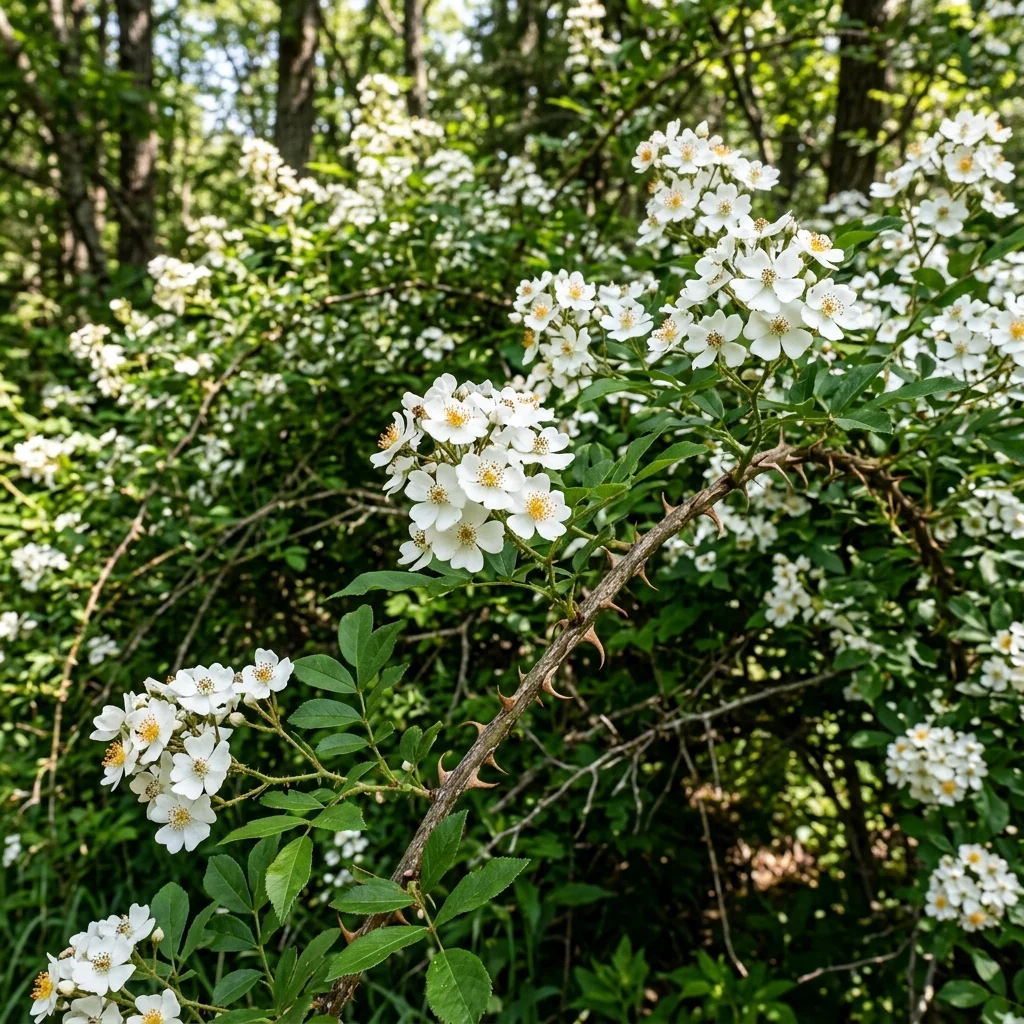
Multiflora Rose is an exceptionally aggressive, sprawling, thorny perennial shrub native to East Asia. Introduced to North America in the 1930s for erosion control and as a 'living fence' for livestock, it has become a major agricultural disaster. It features long, arching, cane-like stems armed with sharp curved thorns, forming massive, dense, impenetrable thorny thickets up to 15 feet wide that completely block pastures, forest margins, and home garden edges, outcompeting all native flora.


Sunlight Icon
Sunlight Full Sun to Partial Shade
Watering Icon
Watering Tolerance Low to Moderate
Soil Mix Icon
Soil Adaptability Any Soil / Loam / Clay
Temperature Icon
Growth Temp 5°C - 38°C
Toxicity Danger Icon
Danger / Toxicity Sharp Thorns / Dense Thickets
Botanical macro photography of Multiflora Rose (Rosa multiflora) - Plant AI care and control database

How to Identify Multiflora Rose

A large, thorny, arching perennial shrub forming dense thickets, with compound leaves showing fringed leaf stalks, and small clusters of white flowers.

  • Fringed Leaf Stalks (Fringed Stipules): The base of each compound leaf stalk features a highly distinct, deeply fringed, hair-like leaf structure (stipule).
  • Sharp Curved Thorns: The long, arching green-red stems (canes) are densely armed with exceptionally sharp, curved thorns resembling cat claws.
  • Clusters of White Flowers: Small, fragrant white-to-pale-pink flowers (2 cm wide) with exactly 5 petals, blooming in late spring in abundant clusters.
💡 Plant AI Tip: Multiflora Rose canes can root at the tips! When the long arching canes bend and touch the soil, they grow roots, forming a brand new plant. This vegetative growth allows thickets to expand rapidly.

Complete Care & Management Guide

Access highly technical, scientific management directives to control or cultivate Multiflora Rose effectively.

Highly drought-tolerant once established due to its extensive, deep woody root system. It thrives in dry pasture hills but also tolerates damp forest borders.
Moderately controlled by regular mowing. Mowing arching canes repeatedly for 3-4 consecutive seasons exhausts the woody root reserves, slowing thicket growth.
Highly aggressive. It absorbs high levels of nitrogen and soil nutrients, leaving neighboring pasture grasses starved and forming dense monocultures.
Prefers Full Sun to achieve maximum flowering and thicket growth. However, it is moderately shade-tolerant, easily colonizing understory margins.
Adapts to clay, rich loam, sandy loam, and gravelly orchard beds, provided the substrate is well-drained. It struggles in swampy soils.
Spreads aggressively by seeds and rooting cane tips. A single shrub can produce up to 1 million seeds packed in bright red rose hips, which are eaten and spread by birds.
Extremely cold-hardy perennial woody shrub. The arching canes remain green all winter, surviving freezing temperatures easily to sprout in spring.
Features a massive, deep, woody taproot system anchored to a thick central crown. Complete manual extraction requires a heavy spade and thick leather gloves.
Targeted by the rose rosette virus (spread by mites) and the rose seed chalcid, which acts as a helpful natural biological control, stunting thicket growth.
Subject to **Black Spot Fungus** and **Powdery Mildew** in damp seasons, though diseases rarely kill the tough woody root crown.
To control Multiflora Rose organically, prune the arching canes close to the base, and manually excavate the woody root crown using a sharp spade. Do not compost the red rose hips.

Are your yard borders showing arching thorny canes or dense white rose clusters?

Dig out the central woody root crown, prune arching canes to prevent tip rooting, and check for fringed leaf stalks.

Diagnose Weed Instantly

Common Diseases & Treatment

Black Spot Fungus

Symptoms: Symptoms: Circular black spots with fringed borders appearing on the green leaves, causing them to turn yellow and drop.

Action: Action: Clip and dispose of infected canes. Avoid overhead watering to keep leaf surfaces dry, and ensure proper air circulation.

Tip-Rooting Expansion

Symptoms: Symptoms: Arching canes bend down and root in the soil, forming new thorny rosettes around the mother shrub.

Action: Action: Prune the arching canes in autumn before they touch the soil. Dig out any newly rooted tip runners using a trowel.

Frequently Asked Questions

How is Multiflora Rose different from native wild roses?

Multiflora Rose always has deeply fringed stipules (leaf-like hairs) at the base of the leaf stalk. Native roses have smooth, non-fringed stipules, produce larger, pink flowers in small numbers, and do not form massive impenetrable thickets.

Why was Multiflora Rose introduced to North America?

In the 1930s, the US government actively promoted planting Multiflora Rose as a 'living fence' to contain livestock, for erosion control, and to provide wildlife cover. It escaped cultivation and rapidly invaded pasture lands.

Can I feed the red rose hips to my chickens or pets?

Rose hips are rich in vitamin C and are non-toxic, but the seeds have small, irritating hairs. Wild birds feed heavily on them, but domestic pets should avoid eating large quantities. Chickens can safely peck them in pasture land.

What is the best way to eradicate a mature Multiflora Rose thicket?

First, use thick leather brush gloves and loppers to cut away the arching thorny canes to access the base of the shrub. Next, use a sharp spade to dig out the central woody root crown. Pulling or cutting alone will trigger vigorous regrowth.

No more dying plants. Grow healthy greens today!

Get Started for Free