Musk Thistle Identification & Control
Musk Thistle, also widely known as Nodding Thistle or Nodding Plumeless Thistle, is an exceptionally aggressive, heavily armed biennial broadleaf weed in the Asteraceae family. Globally naturalized, it is classified as a highly noxious agricultural weed in North America and pastures. It grows up to 6 feet tall, featuring deeply-lobed spiny leaves and exceptionally large, showy pinkish-purple flower heads that characteristically nod or droop at maturity, emitting a strong musky scent.





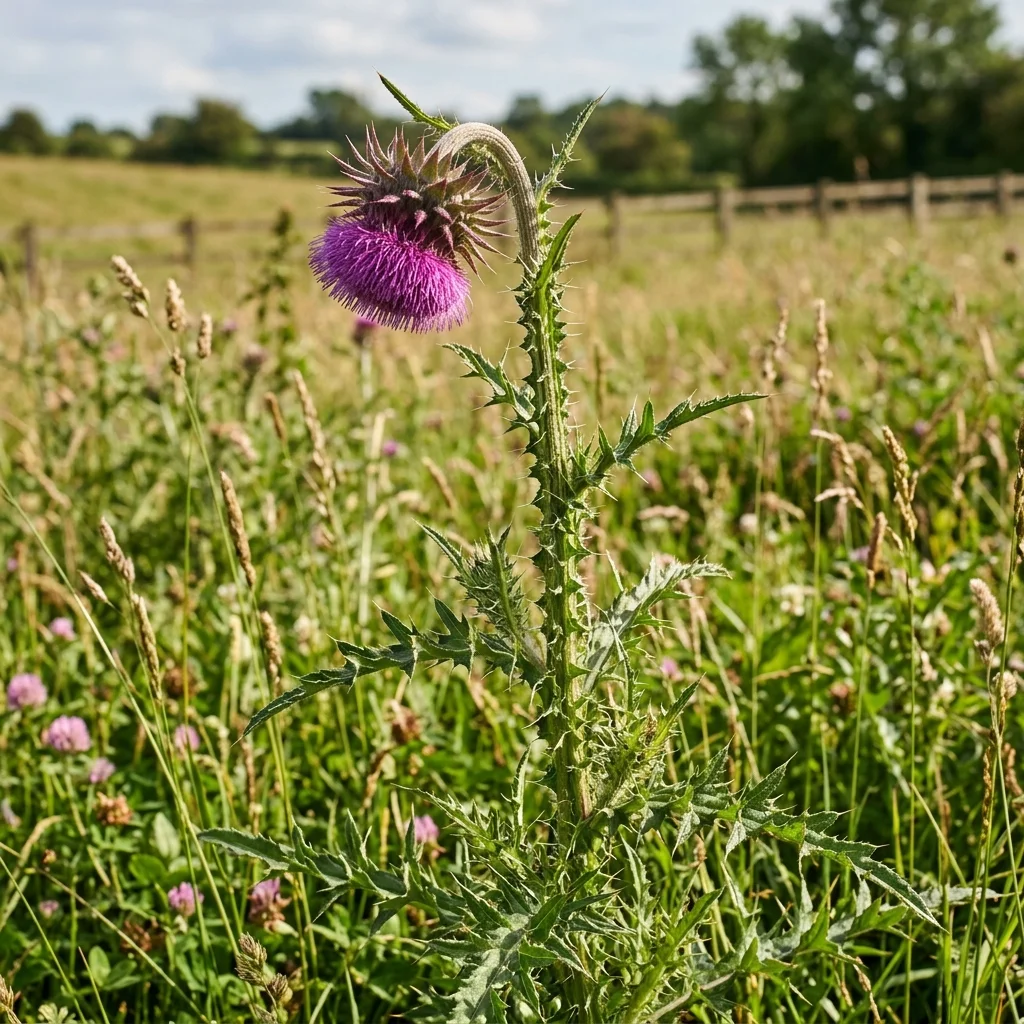
How to Identify Musk Thistle
An upright biennial up to 6 feet tall with spiny stems, deeply lobed leaves showing white margins, and exceptionally large, nodding purple flower heads.
-
✔
Nodding Purple Flower Heads: Exceptionally large, showy pinkish-purple flower heads (3 to 7 cm wide) that droop or nod charakteristisch at stem tips.
-
✔
Spiny White-Margined Leaves: Deeply-lobed, waxy-green leaves show a highly distinct, pale white-to-light-green margin tipped with sharp spines.
-
✔
Erect Spiny-Winged Stems: Stems are upright, highly branched, and possess vertical vertical leaf-like wings covered in stiff, sharp needle spines.
Complete Care & Management Guide
Access highly technical, scientific management directives to control or cultivate Musk Thistle effectively.
Common Diseases & Treatment
Noxious Meadow Takeover
Symptoms: Open meadow soil is completely overtaken by tall, spiny musk thistles, forcing out native forage grass.
Spine Scratch Infection
Symptoms: Sharp yellow spines scratch human skin during hand-pulling, causing immediate itching and redness.
Frequently Asked Questions
Why is it called 'Musk' Thistle and 'Nodding' Thistle?
It is called 'Musk' Thistle because the purple flower heads emit a sweet, pungent, musky fragrance. 'Nodding' Thistle refers to the heavy, mature flower heads, which characteristically bend downward at a 90-degree angle from the stem tip.
Why is Musk Thistle classified as a 'Noxious' Weed?
It is an incredibly aggressive, non-native invader that colonizes pasture soils rapidly, outcompeting valuable livestock forage. Livestock refuse to graze near it due to the sharp needle-spined foliage, severely reducing the carrying capacity of pastures.
Does it have a natural biological control?
Yes. The musk thistle seed head weevil (Rhinocyllus conicus) was introduced in North America as a biological control. The female weevil lays eggs on the flower buds, and the larvae feed heavily on the developing seeds, preventing reproduction.
What is the best way to get rid of it?
Wear thick leather gloves. Slice the central taproot 3 inches below the soil surface using a sharp spade while the plant is still in its flat rosette stage in late spring. Bag the plant to prevent seed spread.