Nutsedge Identification & Control
Nutsedge, commonly referred to as 'Nut Grass', is not a true grass but an aggressive perennial sedge that stands as one of the most stubborn and invasive weeds in home lawns, vegetable gardens, and crop fields globally. Spreading primarily via an underground network of creeping rhizomes and tiny, resilient tubers (nutlets), it thrives in moist, poorly drained soils but easily tolerates severe drought. Once established, its rapid growth rate easily outpaces standard lawn grasses, forming unsightly light-green patches.





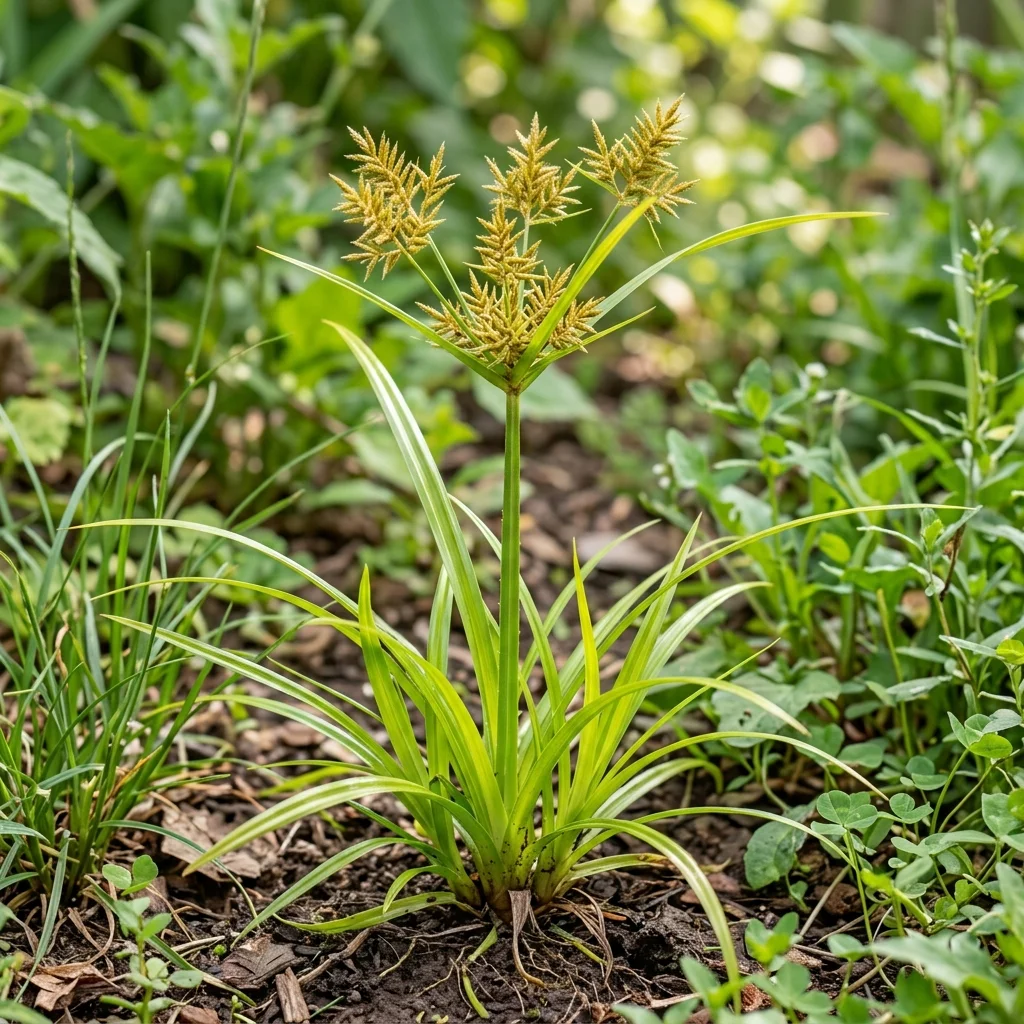
How to Identify Nutsedge
A rapid-growing, erect perennial sedge distinguished by its triangular stems, shiny yellow-green leaves, and cluster of scaly underground tubers.
-
✔
Triangular Stems: Sedges have edges! The base of the stem is distinctly 3-sided and triangular, which you can easily feel by rolling it between your fingers.
-
✔
Shiny Yellow-Green Color: Its waxy, narrow leaves are lighter and shinier than standard turfgrass, making it stand out as a lighter patch in lawns.
-
✔
Umbrella-Like Seed Heads: Produces a cluster of yellowish or purple-brown, narrow spikelets arranged in an umbrella-like cluster at the top of a stiff stem.
Complete Care & Management Guide
Access highly technical, scientific management directives to control or cultivate Nutsedge effectively.
Common Controls & Treatment
Chemical Eradication
Symptoms: Waxy, triangular stems shoot up rapidly above turf heights, ruining the lawn's texture.
Tuber Suffocation
Symptoms: Nutlets sprout aggressively inside raised garden beds or under gravel paths.
Frequently Asked Questions
Why is pulling Nutsedge by hand discouraged?
Hand-pulling Nutsedge usually triggers a survival mechanism called 'tubers splitting'. When you pull the stem, the small underground tubers (nutlets) break off and remain in the soil. This stimulates dormant buds to sprout, resulting in 3 to 5 new plants growing where there was only one.
How do you tell the difference between Nutsedge and regular lawn grass?
Nutsedge has a highly unique triangular stem. If you roll the base of the stem between your fingers, you will feel distinct edges (grasses have round or flat stems). Additionally, Nutsedge has a lighter, yellow-green color and grows much faster than turfgrass in hot weather.
What herbicide kills Nutsedge without killing lawn grass?
Standard broadleaf weed killers will not work on sedges. You must use selective herbicides containing active ingredients like Halosulfuron-methyl or Sulfentrazone, which are specifically designed to target sedges while leaving turfgrass unharmed.