Oriental Bittersweet Identification & Control
Oriental Bittersweet is an exceptionally aggressive, woody perennial climbing deciduous vine native to East Asia. Introduced to North America in the late 19th century as an ornamental landscaping vine, it has become a devastating forest and backyard weed. Spreading vigorously as a twining vine, it wraps tightly around mature trees like a boa constrictor. It performs a classic 'girdling' action—squeezing the trunk so tightly that it chokes off the tree's vascular sap flow, eventually snapping or killing the host tree.





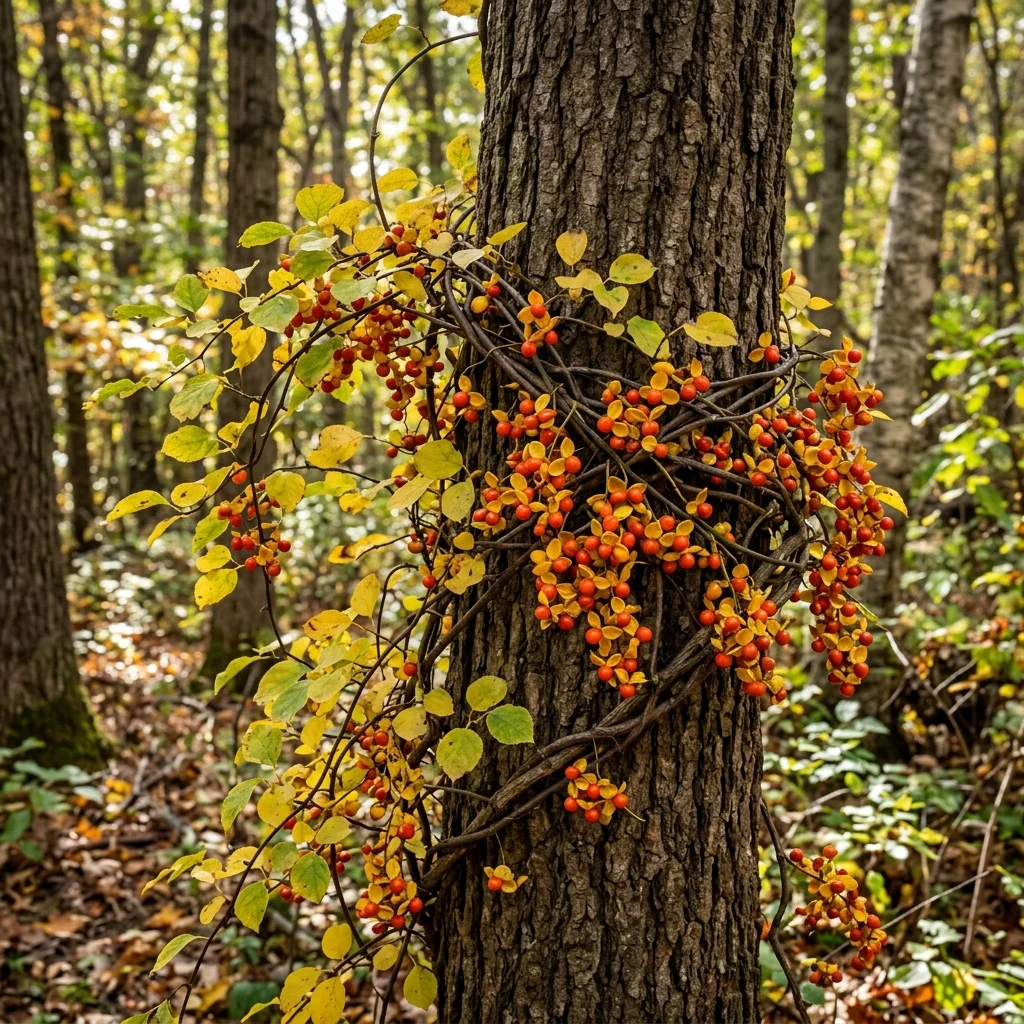
How to Identify Oriental Bittersweet
A twining woody vine with rounded, finely-toothed green leaves, bright orange-yellow roots, and yellow capsules splitting to reveal red berries.
-
✔
Girdling Twining Stems: The woody stems wrap around tree trunks strictly in a twining (spiral) fashion, squeezing the host tree's trunk as it expands.
-
✔
Rounded Toothed Leaves: Alternate, glossy-green leaves that are distinctly rounded or egg-shaped (5 to 10 cm long) with finely toothed margins.
-
✔
Yellow-Red Berries: Autumn brings showy yellow capsules that split open to reveal brilliant, bright-scarlet red berries, clustered along the vine stems.
Complete Care & Management Guide
Access highly technical, scientific management directives to control or cultivate Oriental Bittersweet effectively.
Common Diseases & Treatment
Tree Girdling
Symptoms: Host tree bark develops deep spiral grooves where the bittersweet vine wraps, leading to wilting canopy leaves.
Red Berry Explosion
Symptoms: Brilliant red berries wrapped in yellow capsules cover your winter trees, attracting birds that spread seeds.
Frequently Asked Questions
How does Oriental Bittersweet strangle trees?
Unlike English Ivy which climbs using sticky rootlets, Oriental Bittersweet climbs by twining spirally around tree trunks. As the host tree and the bittersweet vine expand in diameter, the vine acts like a tourniquet, squeezing the bark and cutting off the tree's vascular sap flow (girdling).
Why are the roots bright orange?
The bark of Oriental Bittersweet roots contains high concentrations of natural yellow-orange carotenoid pigments and tannins, giving the root network a highly distinct, bright neon-orange to yellow color that makes it instantly recognizable when dug up.
Is the plant toxic to horses or pets?
Yes. All parts of Oriental Bittersweet, especially the attractive red berries and leaves, contain toxic saponins. If consumed by horses, sheep, dogs, or cats, it can cause severe gastrointestinal irritation and vomiting.
What is the best way to eradicate Oriental Bittersweet organically?
For young seedlings, pull them by hand, ensuring you pull the bright orange taproot out intact. For mature established vines, perform a 'cut-stump' method: cut the thick vine at the base, and use a sponge to apply horticultural vinegar to the cut stump to kill the root system.