Poison Hemlock Identification & Control
Poison Hemlock is an exceptionally hazardous, highly toxic biennial broadleaf weed famed throughout history as the lethal potion that executed the philosopher Socrates. Native to Europe and North Africa, it has successfully colonized wet pastures, home gardens, and roadsides globally. Growing into a massive, fern-like weed up to 10 feet tall, the entire plant is saturated with highly toxic alkaloids, primarily coniine. A tiny dose of several milligrams is fatal to humans and livestock on ingestion, causing rapid respiratory paralysis.





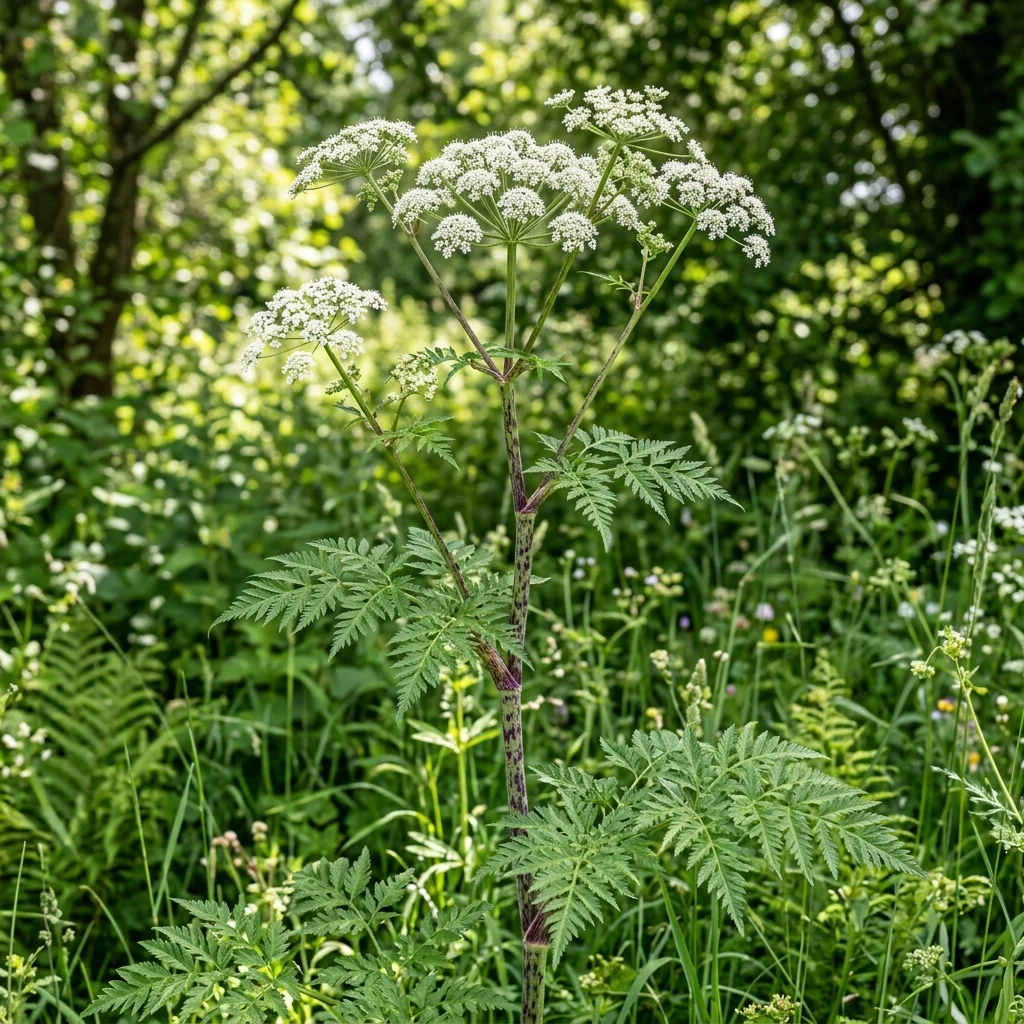
How to Identify Poison Hemlock
A tall, erect biennial with completely smooth, hairless, purple-spotted hollow stems, fern-like leaves, and flat umbrella-shaped white flower clusters.
-
✔
Purple-Spotted Hollow Stems: Stems are strictly smooth (completely hairless), hollow, bright green, and heavily dotted with highly distinct, purple-red spots.
-
✔
Fern-Like Glossy Leaves: Deeply divided, lace-like, glossy-green leaves that resemble parsley or wild carrot leaves, emitting a musty mouse-like scent when crushed.
-
✔
Umbrella-Shaped White Umbels: In its second year, it sprouts tall branched stalks topped with flat, umbrella-like clusters (umbels) of tiny white 5-petaled flowers.
Complete Care & Management Guide
Access highly technical, scientific management directives to control or cultivate Poison Hemlock effectively.
Common Diseases & Treatment
Hemlock Moth Attack
Symptoms: Hordes of small caterpillars chew and roll the leaves, defoliating the tall flower stalks organically.
Accidental Ingestion
Symptoms: Livestock or pets consume leaves or seeds, leading to immediate salivation, muscle trembling, pupil dilation, and respiratory paralysis.
Frequently Asked Questions
How is Poison Hemlock different from Queen Anne's Lace (Wild Carrot)?
Remember: 'The Queen has hairy legs.' Queen Anne's Lace stems are covered in dense, stiff hairs and are solid green. Poison Hemlock stems are completely smooth (hairless), hollow, and covered in distinctive purple spots. Also, Queen Anne's Lace has a dark-purple flower in the center, which Hemlock lacks.
How toxic is Poison Hemlock?
It is extremely toxic. Consuming just 6 to 8 fresh leaves (or a tiny dose of 100 milligrams of sap) is fatal to an adult human. It paralyzes the respiratory muscles, causing death by suffocation while the victim remains fully conscious.
Can I get a rash from touching Poison Hemlock?
Yes. The toxic alkaloids, primarily coniine, can be absorbed through the skin, especially if you have cuts or if the sap is rubbed into the skin, causing mild numbness, irritation, or systemic poisoning. Always wear gloves.
What is the best way to dispose of Poison Hemlock after pulling?
Never burn or compost it. Put all pulled plants in double-layer heavy plastic trash bags, seal them tightly, and send them to a landfill. Burning vaporizes the toxins into the smoke, which can cause severe lung poisoning if inhaled.