Polygonum aviculare

Prostrate Knotweed Identification & Control

Prostrate Knotweed, also known as Doorweed, Stone Weed, or Wireweed, is an exceptionally tough, highly resilient annual broadleaf weed in the buckwheat family. Globally naturalized, it is famous for its extreme ability to survive severe soil compaction and heavy foot trampling. It thrives in gravel driveways, compacted lawn paths, and dry clay sports fields, forming flat, wiry, multi-branched mats that outcompete weak grasses. It has swollen stem joints wrapped in papery sheaths and tiny pink-white flowers.


Sunlight Icon
Sunlight Full Sun to Partial Shade
Watering Icon
Watering Tolerance Low to Moderate
Soil Mix Icon
Soil Adaptability Highly Compacted Clay / Sterile / Gravel
Temperature Icon
Growth Temp 5°C - 38°C
Toxicity Danger Icon
Danger / Toxicity Pet Safe / Compaction Indicator
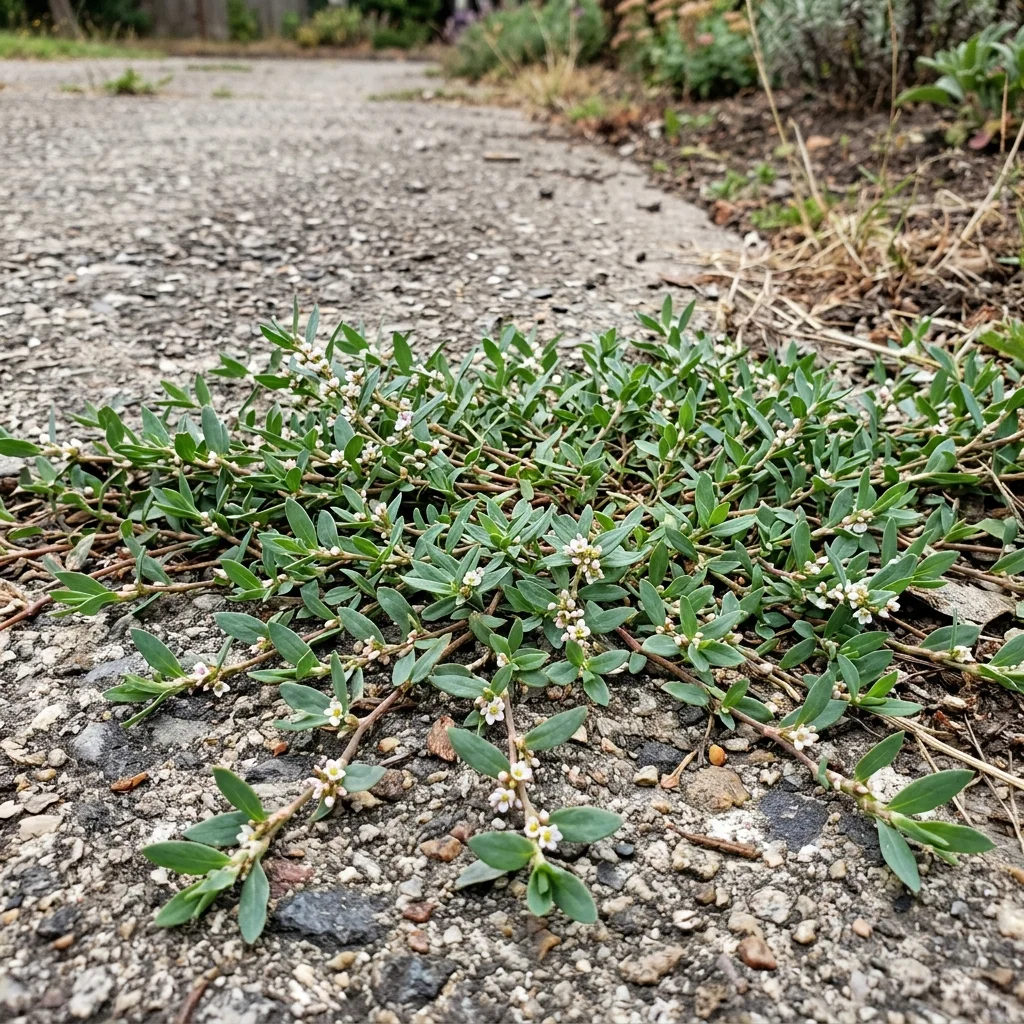
Botanical macro photography of Prostrate Knotweed (Polygonum aviculare) - Plant AI care and control database

How to Identify Prostrate Knotweed

A low-growing, wiry annual forming flat mats, with narrow, blue-green alternate leaves, papery sheaths at stem joints, and tiny pinkish-white flowers.

  • Wiry Swollen Stems: Stems are exceptionally tough, wiry, highly branched, and show swollen joints wrapped in papery sheaths (ochreae).
  • Narrow Blue-Green Leaves: Small, alternate, oblong-to-linear leaves (1 to 3 cm long) with a distinct blue-green waxy tint.
  • Tiny Pink-White Flowers: Inconspicuous clusters of tiny white-to-pink 5-lobed flowers blooming in leaf joints from summer to autumn.
💡 Plant AI Tip: Prostrate Knotweed is the ultimate indicator of severely compacted and oxygen-starved soil! It sprouts in compacted clay where grass roots suffocate and die, acting as a warning to aerate your lawn.

Complete Care & Management Guide

Access highly technical, scientific management directives to control or cultivate Prostrate Knotweed effectively.

Extremely drought-tolerant once established due to its deep taproot. It survives dry summer compaction baking that completely parches and kills surrounding lawn grass.
Resistant to mowing. The wiry stems grow flat to the ground below mower height, and the wood-like fibers are so tough they frequently dull lawn mower blades without being cut.
Thrives in sterile, low-oxygen, nitrogen-deficient soils. Regular lawn fertilization and core aeration allow grass to compete and crowd out the weed.
Prefers Full Sun but exhibits moderate shade tolerance, allowing it to colonize shaded pathway margins and compact orchard margins.
Thrives in heavily compacted clay, gravel pathways, and dry sandy dirt yards. It struggles in loose, highly aerated organic potting mixes.
Reproduces strictly by seeds. A single plant can produce up to 6,000 tiny, triangular seeds that can remain dormant in compacted soil for over 30 years.
Extremely cold-hardy annual. Seeds germinate in early spring when soil temperatures are just 40°F (4°C). The entire plant dies with hard winter frost.
Features an exceptionally deep, thin, wiry vertical taproot that drills deep into compacted subsoil to extract moisture.
Targeted occasionally by aphids, though insect pressure rarely slows its aggressive colonization of hard compacted ground.
Subject to **Powdery Mildew** in damp autumns, though the white fungal film rarely kills the plant before it successfully seeds.
To control Prostrate Knotweed organically, the absolute best method is to core-aerate your lawn to loosen compacted clay, fertilize, and sow dense competitive grass seeds.

Are your compacted garden paths showing flat wiry mats with blue-green leaves?

Perform lawn core aeration to loosen compacted clay, hand-pull young rosettes, and mow high.

Diagnose Weed Instantly

Common Diseases & Treatment

Powdery Mildew Fungal film

Symptoms: Symptoms: A flour-like white-gray film covering the wiry blue-green leaves in damp autumns, causing them to turn yellow.

Action: Action: Encourage lawn aeration. Bag and discard heavily infected stems to prevent fungal spores from spreading to garden plants.

Compacted Clay Suffocation

Symptoms: Symptoms: Desirable lawn grass dies completely, replaced by flat, wiry, stone-like green mats of knotweed.

Action: Action: Core-aerate the soil immediately. Apply sand top-dressing and overseed with turf grass like Tall Fescue to shade the soil.

Frequently Asked Questions

Why is it called 'Prostrate Knotweed' and 'Wireweed'?

It is called 'Prostrate' because it crawls flat along the ground, and 'Knotweed' due to the distinct swollen, knot-like joints along the stems. 'Wireweed' refers to the wiry, exceptionally tough fibrous stems that can actually dull mower blades.

Is Prostrate Knotweed toxic to dogs?

No, it is completely non-toxic and pet-safe. However, its presence is a loud warning that your soil is heavily compacted, low in oxygen, and hostile to grass.

Does it have any historical uses?

Yes. In traditional European herbalism, it was used as an astringent to stop minor bleeding and treat throat inflammation due to its high tannin content. The seeds are also eaten by wild songbirds.

What is the best way to get rid of it organically?

Since it thrives on soil compaction, mechanical control is only half the battle. Hand-pull young rosettes in spring before the roots grow deep, and then use a core-aerator to loosen the clay soil, allowing grass to take back the area.

No more dying plants. Grow healthy greens today!

Get Started for Free