Prostrate Spurge Identification & Control
Prostrate Spurge, also known as Creeping Spurge or Ground Sand-mat, is an exceptionally stubborn, highly toxic annual broadleaf weed in the Euphorbiaceae family. Native to tropical America but globally naturalized, it is a major nuisance in dry lawns, gravel pathways, and greenhouse floors. It is highly similar to Spotted Spurge but features slightly smaller, uniform green leaves without a red center spot, creeping flat to form dense mats that bleed highly toxic, skin-irritating milky sap when broken.





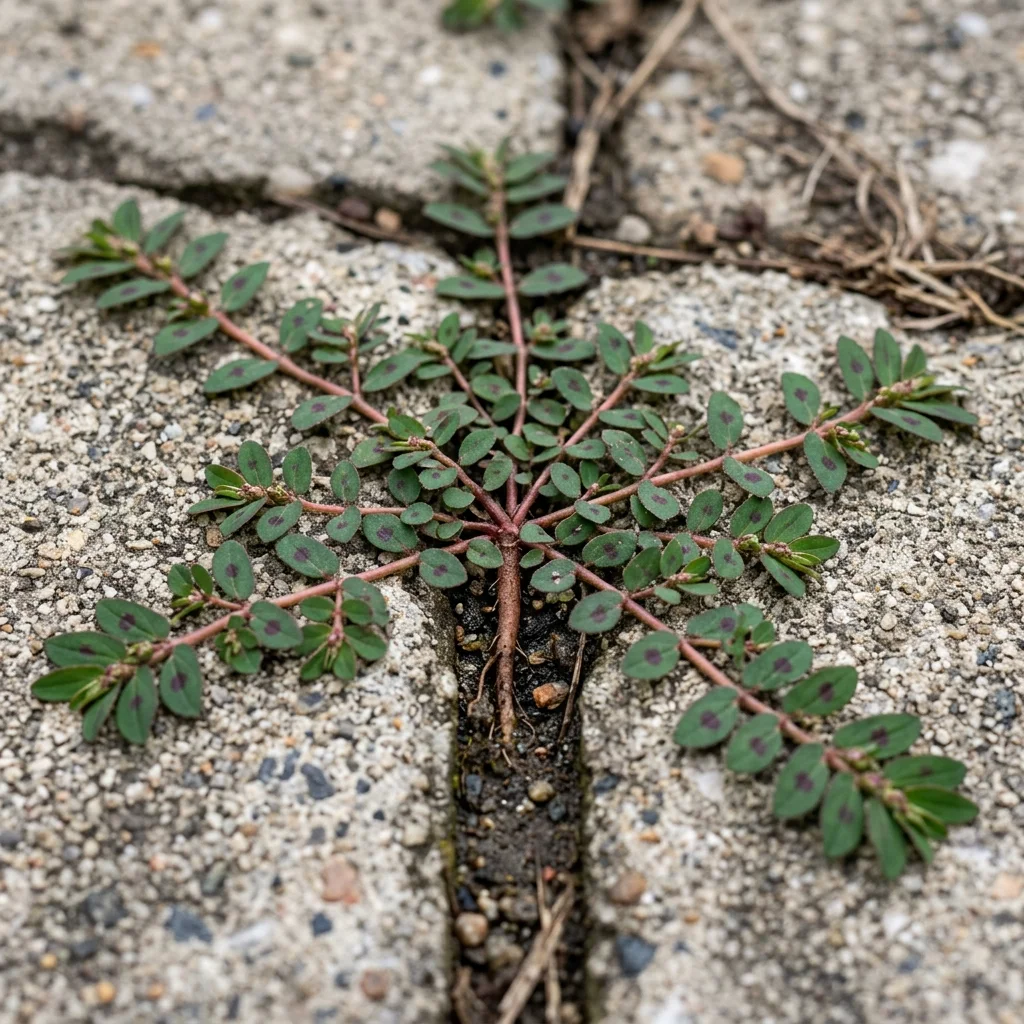
How to Identify Prostrate Spurge
A low-growing annual forming flat green mats radiating from a central root, with tiny uniform green opposite leaves, and toxic white sap.
-
✔
Sticky Milky Sap: Broken stems immediately bleed a thick, sticky, milky-white sap that is highly corrosive and irritating to skin.
-
✔
Tiny Uniform Green Leaves: Opposite oval leaves (3 to 8 mm long) are solid light green-to-reddish green, completely lacking a dark spot.
-
✔
Creeping Prostrate Stems: Stems crawl flat along the ground, highly branched and frequently tinged with a deep pink-red color.
Complete Care & Management Guide
Access highly technical, scientific management directives to control or cultivate Prostrate Spurge effectively.
Common Diseases & Treatment
Toxic Latex Burn
Symptoms: Redness, burning sensations, and skin blisters appearing on hands after pulling broken spurge stems.
Sidewalk Crack Spread
Symptoms: Driveway joints are completely choked by flat, circular green-red mats of spurge.
Frequently Asked Questions
How is Prostrate Spurge different from Spotted Spurge?
Prostrate Spurge (Euphorbia prostrata) has smaller leaves that are solid green without a central red spot. Spotted Spurge (Euphorbia maculata) leaves are larger and feature a highly distinct, dark reddish-purple spot along the midvein.
Is the milky sap toxic to cats?
Yes. Euphorbia sap contains diterpene esters, which are highly irritating to animal mucous membranes. If a cat chews the weed, it can cause severe drooling, mouth swelling, vomiting, and eye irritation if the sap touches their eyes.
Why does it grow so well in sidewalk cracks?
The hot concrete traps heat, warming the soil underneath. This warm sand combined with a lack of competition is perfect for this heat-loving desert native, which thrives on bare gravel and cracked pavement.
What is the best way to get rid of it?
Since it grows from a single, central taproot, hand-pulling is very effective. Grab the center of the mat and pull straight up slowly. Use pre-emergent organic corn gluten meal in early spring to block the seeds.