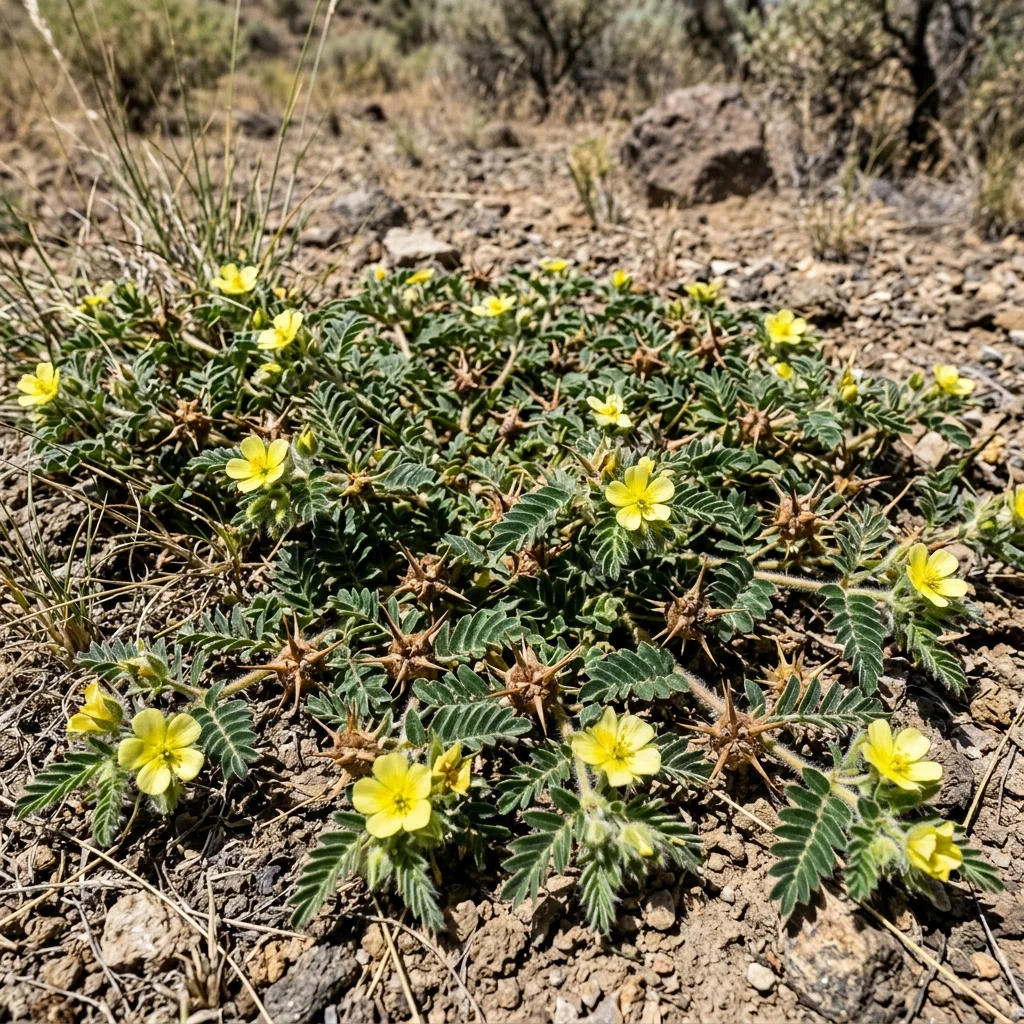
Tribulus terrestris

Puncturevine Identification & Control

Puncturevine, also infamously known as Goathead, Caltrop, or Tackweed, is an exceptionally aggressive, highly toxic prostrate perennial broadleaf weed in the Zygophyllaceae family. Native to the Mediterranean but thoroughly naturalized globally, it is an absolute nightmare in dry, sandy, gravelly, and compacted soils. It forms flat, creeping green mats up to 5 feet wide, producing small yellow 5-petaled flowers that mature into hard, woody seed pods shaped like a goat's head, armed with heavy, needle-sharp horns that easily puncture bicycle tires and pet paws.


Sunlight Icon
Sunlight Full Sun
Watering Icon
Watering Tolerance Very Low
Soil Mix Icon
Soil Adaptability Sterile Sand / Gravel / Hard Compacted
Temperature Icon
Growth Temp 18°C - 48°C
Toxicity Danger Icon
Danger / Toxicity Sharp Goatheads / Tire & Foot Puncture
Botanical macro photography of Puncturevine (Tribulus terrestris) - Plant AI care and control database

How to Identify Puncturevine

A flat, prostrate, carpet-like vine with hairy pinnate leaves, small 5-petaled yellow flowers, and woody goathead-shaped spiny seed burs.

  • Goathead Spiny Seed Burs: Hard, woody seed pods split into 5 star-like segments, each featuring 2 to 4 heavy, needle-sharp horns.
  • Prostrate Creeping Mats: Stems crawl flat along the soil radiating from a central crown, forming dense, multi-branched green-purple mats.
  • Hairy Pinnate Leaves: Opposite compound leaves composed of 4 to 8 pairs of small, oval leaflets covered in fine, silky white hairs.
⚠️ Tire & Paw Alert: Puncturevine seed horns are so strong they can easily puncture bicycle tires, thin shoe soles, and the leather-like paw pads of dogs, earning their nickname 'Goathead'.

Complete Care & Management Guide

Access highly technical, scientific management directives to control or cultivate Puncturevine effectively.

Extremely drought-resistant. Once the deep vertical taproot is anchored, it survives desert-like summer dry spells without dropping its spiny seed pods.
Completely immune to mowing. Since the stems creep flat against the bare soil, lawn mowers pass over them without clipping the flowers or spiny burs.
Thrives in nutrient-barren soils. It outcompetes agricultural crops and lawn grasses in sandy soils by hogging water and setting seeds before other crops can grow.
Requires Full Sun. It cannot tolerate even partial shade and will fail to grow under tree canopies or in dense, shaded lawns.
Prefers sterile sand, dry gravelly roadsides, and highly compacted dirt walkways. It struggles in saturated, boggy clay soils.
Reproduces strictly by seeds. The goathead burs snag on tires, shoes, and animal hoofs. Seeds can remain viable in dry sand for over 15 years.
Extremely heat-tolerant. Thrives in baking summer temperatures up to 120°F (48°C). Dies back completely with winter frosts, leaving hard burs behind.
Features an exceptionally deep, thick vertical yellow taproot that anchors stubbornly into compacted gravel. Extraction requires deep slicing.
Targeted by puncturevine weevils (*Microlarinus lareynii*), which feed on the seeds and stems, serving as an organic biological control.
Rarely suffers from diseases due to its desert adaptation, maintaining highly aggressive growth in sterile substrates.
To control Goatheads organically, manually dig out the central root crown using a sharp weeding knife before the spiny burs harden, and sweep up loose burs.

Are your gravel paths showing flat creeping green mats with goathead-shaped burs?

Dig out the central taproot, sweep loose goathead burs using a flat piece of carpet, and wear thick boots.

Diagnose Weed Instantly

Common Diseases & Treatment

Tire Puncture

Symptoms: Symptoms: Bicycle or wheelbarrow tires go flat repeatedly after rolling through dry gravel margins.

Action: Action: Install thorn-resistant tire liners or slime sealant. Sweep the area with a piece of discarded indoor carpet; the burs cling to it easily.

Goathead Paw Injury

Symptoms: Symptoms: Pets yelp and lift their paws while walking on gravel, with hard woody burs hooked deep in paw pads.

Action: Action: Wear leather gloves and pull out the bur using pliers. Wash the wound with antiseptic, and seek veterinary help if infected.

Frequently Asked Questions

Why is it called 'Goathead' and 'Puncturevine'?

It is named 'Goathead' because the spiny woody bur splits into seed cases that look exactly like the skull of a goat with heavy horns. 'Puncturevine' refers to the sharp horns, which easily puncture bicycle tires, shoes, and paws.

Is Puncturevine chemically toxic?

Yes. It contains toxic steroidal saponins, which cause hepatogenous photosensitization in sheep and goats. Ingestion leads to severe liver damage, swollen ears, and skin necrosis under sunlight.

How do you pick up loose Goathead burs from the ground?

A clever organic trick is to press a piece of discarded thick carpet, cardboard, or foam pad onto the ground. The hooked horns snag the carpet fiber immediately, allowing you to sweep up thousands of burs easily.

What is the best way to get rid of it?

Locate the center of the creeping rosette. Slice the vertical yellow taproot 2 inches below the soil surface using a sharp weeding trowel, and lift the entire vine crown out. Bag and discard. Do not compost.

No more dying plants. Grow healthy greens today!

Get Started for Free