Purple Deadnettle Identification & Control
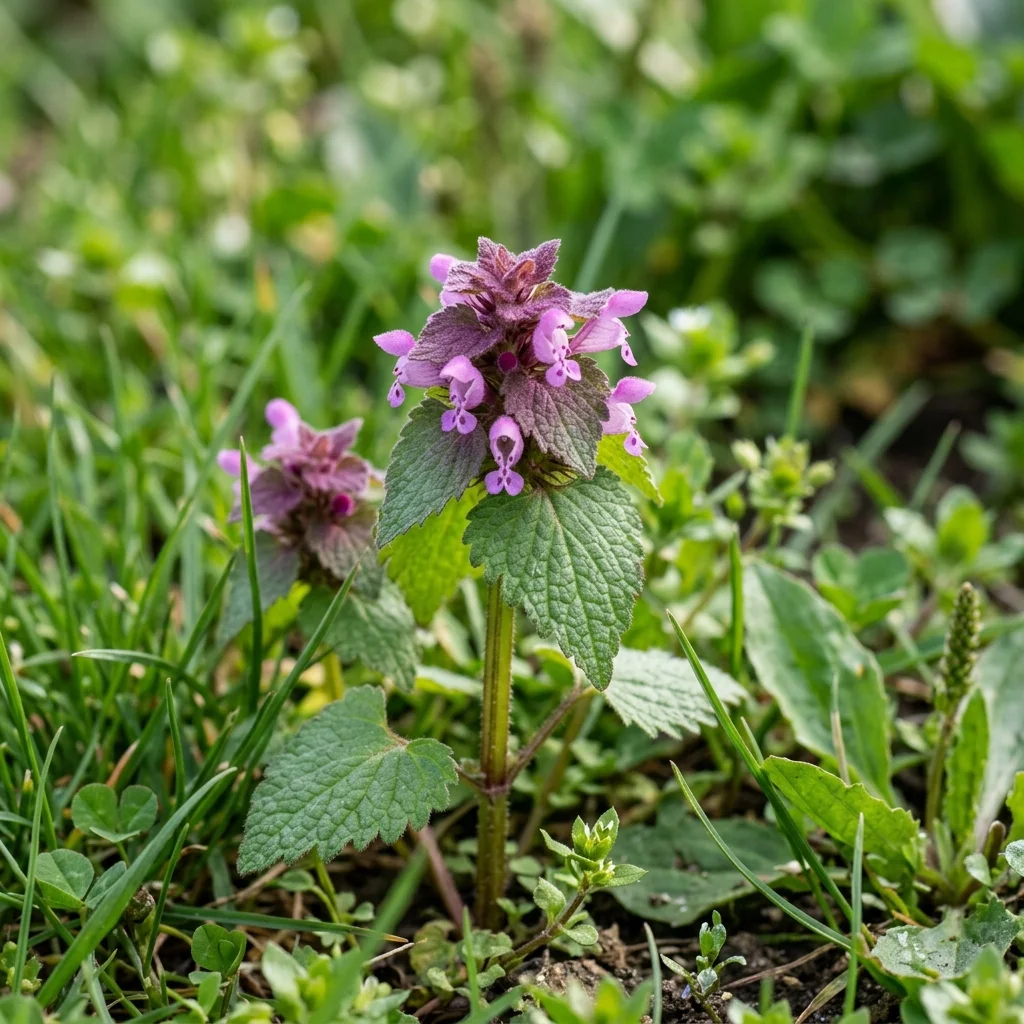
Purple Deadnettle is an exceptionally common winter annual broadleaf weed in the mint family. Native to Europe and western Asia, it has rapidly colonized lawns, crop fields, and home gardens across North America. Famous for its highly striking, colorful foliage, its upper leaves turn a beautiful reddish-purple to deep bronze, clustered tightly at the top of square stems like a tiny pagoda, producing small pink tubular flowers in early spring.





How to Identify Purple Deadnettle
An upright winter annual with square stems, triangular-to-egg-shaped leaves on stalks, with upper leaves turning distinct reddish-purple and clustered at the top.
-
✔
Purple Pagoda Canopy: Upper leaves are densely clustered at the top, pointing downward, and turn a beautiful reddish-purple to deep bronze.
-
✔
Stalked Fuzzy Leaves: Leaves are heart-shaped or triangular, covered in fine fuzzy hairs, and sit on distinct leaf stalks (unlike Henbit).
-
✔
Tiny Pink Flowers: Small, two-lipped, tubular pink flowers (1 cm) emerging from the dense purple canopy in early spring.
Complete Care & Management Guide
Access highly technical, scientific management directives to control or cultivate Purple Deadnettle effectively.
Common Diseases & Treatment
Downy Mildew
Symptoms: Pale yellow patches on leaf tops, with fuzzy grey-purple spore mats underneath during damp spring.
Top Canopy Rot
Symptoms: The dense purple upper leaves turn brown, mushy, and rot during prolonged damp spring rains.
Frequently Asked Questions
Why is it called 'Deadnettle'?
It is called 'Deadnettle' because its leaves strongly resemble those of the Stinging Nettle (Urtica dioica). However, it is 'dead' in terms of sting—it has absolutely no stinging hairs and is completely safe to touch.
Is Purple Deadnettle edible?
Yes. It is a highly nutritious, edible spring herb. The leaves have a mild, slightly sweet, earthy, and herbaceous flavor. They are packed with vitamins, iron, and antioxidants, great in spring smoothies and teas.
How do you tell it apart from Henbit?
Purple Deadnettle has heart-shaped leaves on distinct leaf stalks, and the upper leaves are reddish-purple and pointed downward. Henbit has rounded leaves that clasp directly around the stem without stalks, and is green-purple.
What is the best way to get rid of it?
Simply pull them by hand or scrape them with a hoe in early spring before they set seeds. Because it is a winter annual, applying organic mulch to garden beds in late summer prevents seeds from germinating in autumn.