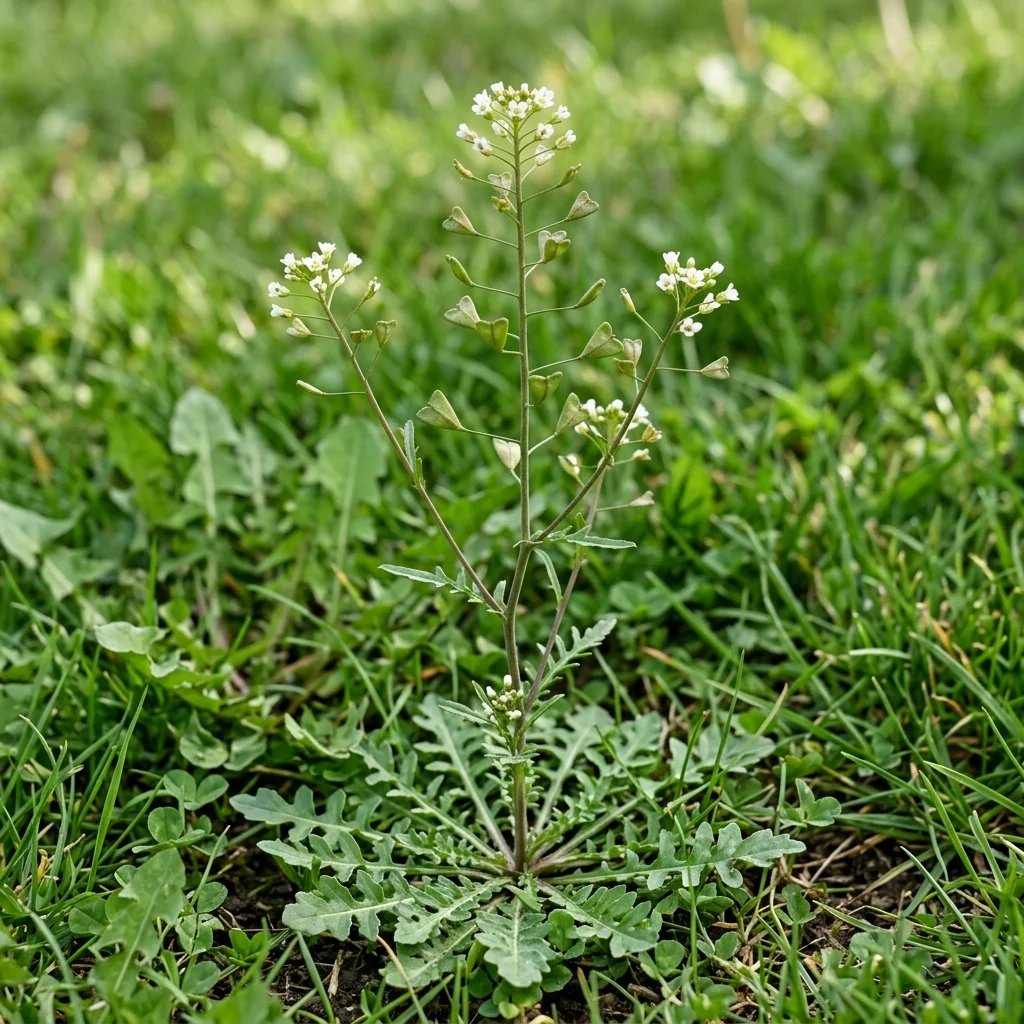
Capsella bursa-pastoris

Shepherd's Purse Identification & Control

Shepherd's Purse is a highly prolific, upright annual broadleaf weed in the mustard family. Native to Europe but thoroughly naturalized globally, it is one of the most common weeds in agricultural fields, home gardens, and roadsides. Instantly recognizable by its highly unique, heart-shaped or triangular seedpods that resemble historical leather purses, it produces thousands of seeds and can complete its entire lifecycle in just a few weeks.


Sunlight Icon
Sunlight Full Sun to Partial Shade
Watering Icon
Watering Tolerance Moderate
Soil Mix Icon
Soil Adaptability Any Soil / Disturbed
Temperature Icon
Growth Temp 5°C - 30°C
Toxicity Danger Icon
Danger / Toxicity Pet Safe / Edible
Botanical macro photography of Shepherd's Purse (Capsella bursa-pastoris) - Plant AI care and control database

How to Identify Shepherd's Purse

An upright annual with a basal rosette of lobed leaves, tall slender stems with tiny white flowers, and distinctive heart-shaped, flat seedpods.

  • Heart-Shaped Seedpods: Small, flat, heart-shaped or triangular seedpods (6 mm) arranged along the upper flower stems, looking like tiny pouches.
  • Tiny White Flowers: Small clusters of tiny white, 4-petaled flowers (2 mm) blooming at the very tips of the tall, slender stems.
  • Lobed Basal Rosette: A flat rosette of deeply lobed, dandelion-like leaves at the base, from which tall, branched stems arise.
💡 Plant AI Tip: The seeds of Shepherd's Purse are protocarnivorous! When wet, they release a sticky mucilage that traps and digests microscopic soil organisms, providing nutrients to the seedling.

Complete Care & Management Guide

Access highly technical, scientific management directives to control or cultivate Shepherd's Purse effectively.

Highly adaptable to dry and damp conditions. It grows vigorously in early spring moisture but survives dry spells by accelerating its seeding cycle, producing seeds and dying in summer.
Controlled effectively by mowing. Mowing cuts off the tall, upright seedheads before the heart-shaped pods open, preventing seed dispersal and disrupting its annual lifecycle.
Thrives in nutrient-poor and highly disturbed soils. Regular fertilization helps garden plants grow densely, shading out emerging shepherd's purse seedlings.
Prefers Full Sun but tolerates partial shade. It struggles under dense forest canopies and dense, thick lawn turf shading. Shading lawns suppresses it.
Thrives in newly tilled soils, gardens, crop fields, and roadsides. It easily grows in dry, compacted, or poor soils where other plants struggle.
Reproduces strictly by seeds. A single plant can produce up to 40,000 seeds. Seeds can survive in the soil for over 30 years, germinating when soil is turned.
An annual or winter annual. It can germinate in autumn or spring, growing rapidly in cool weather (10-20°C) and dying out quickly in hot mid-summer temperatures.
Features a slender, relatively thin taproot with fine lateral roots. It is exceptionally easy to hand-pull or hoe out due to its weak root structure.
Occasionally targeted by flea beetles and aphids, often acting as a reservoir host for these pests in vegetable gardens.
Subject to **White Rust** (white chalky blisters on leaves) and **Downy Mildew**. *Action*: Pull and discard infected plants. Avoid overhead watering.
Shepherd's Purse is extremely easy to control manually due to its weak taproot. Hand-pull in spring before the heart-shaped pods turn brown and open, and mulch garden beds heavily.

Is your garden full of heart-shaped seed pouches or tiny white flowers?

Hand-pull the slender taproot easily in spring, check for heart-shaped flat pods, and mow before pods open.

Diagnose Weed Instantly

Common Diseases & Treatment

White Rust

Symptoms: Symptoms: Chalky white, raised pustules appearing on the leaves and stems, causing them to distort.

Action: Action: Hand-weeding. Remove infected plants to prevent spore spread. Avoid overhead irrigation and keep leaf surfaces dry.

Rapid Seeding

Symptoms: Symptoms: The heart-shaped seedpods turn yellow-brown, dry, and split open, releasing thousands of tiny seeds.

Action: Action: Pull immediately! The seeds can survive in the soil for decades. Hand-pull the weed the moment you see the heart-shaped pods forming.

Frequently Asked Questions

Why is it called 'Shepherd's Purse'?

It is named 'Shepherd's Purse' (Capsella bursa-pastoris) because the flat, heart-shaped or triangular seed capsules strongly resemble the traditional leather pouches or purses carried by shepherds in antiquity.

Is Shepherd's Purse edible?

Yes. It is a highly popular edible herb in East Asia (known as 'Jicai' in China). The young leaves have a pleasant, slightly peppery, nutty flavor, rich in vitamins. Traditionally used in stir-fries, soups, and dumpling fillings.

How long do the seeds survive in the soil?

The seeds are incredibly durable. They can remain dormant and viable in the soil for 30 years or more, germinating rapidly when the soil is tilled or disturbed and exposed to sunlight.

What is the best way to get rid of it?

Simply pull them by hand or scrape them with a hoe in early spring before the seedpods open. Applying a 2-inch layer of organic mulch to garden beds prevents light from reaching the seeds, stopping germination.

No more dying plants. Grow healthy greens today!

Get Started for Free