Ailanthus altissima

Tree of Heaven Identification & Control

Tree of Heaven, also infamously known as Ailanthus, Ghetto Palm, or Stinking Sumac, is an exceptionally aggressive, fast-growing deciduous perennial woody tree. Native to Northeast China, it was introduced to the West in the late 18th century as an exotic landscape tree but has become a severe ecological disaster. Growing up to 8 feet per year, it cracks urban pavement, damages sewer lines, and releases highly toxic allelopathic chemicals that kill surrounding plants. Furthermore, it is the primary host for the destructive Spotted Lanternfly agricultural pest.


Sunlight Icon
Sunlight Full Sun to Partial Shade
Watering Icon
Watering Tolerance Low
Soil Mix Icon
Soil Adaptability Any Soil / Sandy / Compacted / Cracked Concrete
Temperature Icon
Growth Temp -15°C - 45°C
Toxicity Danger Icon
Danger / Toxicity Highly Allelopathic / Foundation Damage
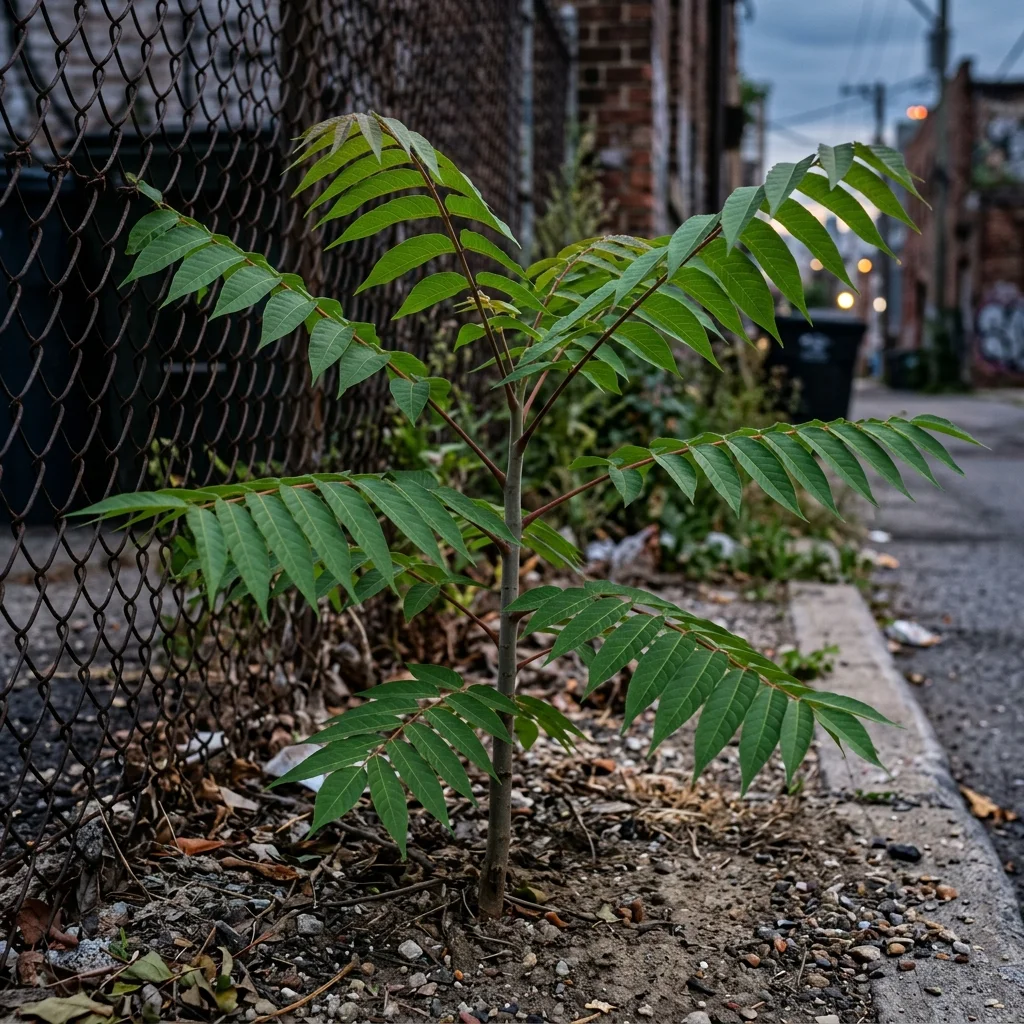
Botanical macro photography of Tree of Heaven (Ailanthus altissima) - Plant AI care and control database

How to Identify Tree of Heaven

A fast-growing woody tree with long pinnate compound leaves showing small glands at the leaflet base, emitting a rancid peanut butter smell when crushed.

  • Rancid Peanut Butter Aroma: Crushing the leaves, breaking the twig bark, or cutting the wood releases a highly distinct, nauseating, rancid odor resembling burnt peanut butter.
  • Base Glands on Leaflets: Long pinnate compound leaves (up to 3 feet long) carry 10 to 40 leaflets, each showing a tiny, raised bump (gland) near the bottom leaflet edges.
  • Smooth Pale-Grey Bark: The bark is exceptionally smooth, light-grey to pale-brown, with subtle vertical fissures as the tree matures, looking like cantaloupe skin.
⚠️ Spotted Lanternfly Alert: Tree of Heaven is the primary host and favorite breeding ground for the highly destructive **Spotted Lanternfly** (*Lycorma delicatula*). Removing this tree from your yard is critical to protecting local orchards and vineyards from lanternfly damage.

Complete Care & Management Guide

Access highly technical, scientific management directives to control or cultivate Tree of Heaven effectively.

Extremely drought-tolerant. It thrives in dry, sunny urban concrete joints and parched roadsides, surviving severe droughts easily due to its tough, deep taproot system.
Extremely resistant to pruning. Cutting down a tree of heaven triggers a defensive survival response, forcing the underground lateral roots to shoot up hundreds of root suckers in a 50-foot radius.
Highly aggressive. It releases a powerful allelopathic chemical called **ailanthone** from its roots and leaves, which actively poisons and kills surrounding garden flora.
Requires Full Sun. It cannot tolerate shade and will fail to grow under a dense forest canopy. It quickly climbs urban structures to capture sunlight.
Adapts to clay, gravel, dry rocky slopes, parched urban soils, and concrete joints. It does not require loose, rich organic soils.
Spreads aggressively by seeds and root suckers. A single mature female tree can produce up to 325,000 winged papery seeds (samaras) carried miles by wind.
Extremely cold-hardy perennial woody tree. Survives severe winter freezes easily, sprouting vigorous new wood shoots in early spring.
Features an exceptionally deep vertical taproot and an extensive, aggressive lateral root network capable of breaking building foundations and sewage pipes.
Targeted by the spotted lanternfly, which feeds heavily on the sap. It is also host to the ailanthus webworm moth, though pests rarely kill mature trees.
Subject to **Verticillium Wilt** fungus, which can cause sudden branch wilting and death, acting as a potential biological control agent.
Never cut down a Tree of Heaven without treating the stump! To kill it organically, apply a systemic herbicide (Triclopyr) directly to the freshly cut stump surface, or use the 'hack and squirt' method.

Is your urban yard showing fast-growing sumac-like trees or pavement cracks?

Treat cut stumps with systemic herbicides to prevent root suckering, remove spotted lanternflies, and inspect leaflet base glands.

Diagnose Weed Instantly

Common Diseases & Treatment

Allelopathic Poisoning

Symptoms: Symptoms: Surrounding garden plants turn yellow, develop stunted growth, and die due to chemical toxins in the soil.

Action: Action: Remove the tree. Apply organic activated charcoal to the surrounding soil to absorb and neutralize the remaining ailanthone toxins.

Aggressive Root Suckering

Symptoms: Symptoms: Hundreds of new tree shoots sprout rapidly from your lawn and garden beds after you chopped down the main trunk.

Action: Action: Root suckering alert! Cutting stimulated the lateral roots. You must treat the newly erupted suckers immediately with systemic herbicide or dig out the root chains.

Frequently Asked Questions

Why is Tree of Heaven considered a severe ecological threat?

It grows incredibly fast (up to 8 feet a year), outcompeting native trees for light. Furthermore, its roots and leaf litter secrete ailanthone, a natural poison that stunts and kills other plants, and its roots damage urban concrete and foundations.

Why does it smell like rancid peanut butter?

The leaves and twigs contain specialized volatile oils and compounds (specifically high-nitrogen amines) that emit a strong, highly distinct, nauseating odor resembling rancid or burnt peanut butter when crushed.

How do you distinguish Tree of Heaven from Black Walnut?

Tree of Heaven leaflets have completely smooth margins except for a small gland (bump) near the base of each leaflet, and they smell like rancid peanut butter. Black Walnut leaflets are finely toothed along the entire margin and have a pleasant, citrusy-spicy scent.

What is the best way to kill Tree of Heaven permanently?

Do not simply chop it down. You must use the 'hack-and-squirt' method: use a hatchet to make downward cuts through the bark around the trunk, and squirt a systemic herbicide (Triclopyr) into the cuts. The tree will carry the chemical to the roots, preventing suckering.

No more dying plants. Grow healthy greens today!

Get Started for Free