Wild Parsnip Identification & Control
Wild Parsnip is an exceptionally hazardous, highly persistent biennial broadleaf weed in the parsley family. Famed for its bright yellow flower heads and highly edible taproot, it has Escaped cultivation to become a major public health hazard along roadsides, pastures, and home garden edges. Like Giant Hogweed, the entire plant is saturated with highly toxic furanocoumarins in its sap. Contact with this sap followed by exposure to sunlight causes severe, painful phytophotodermatitis, resulting in intense skin blistering and long-lasting hyperpigmented scars.





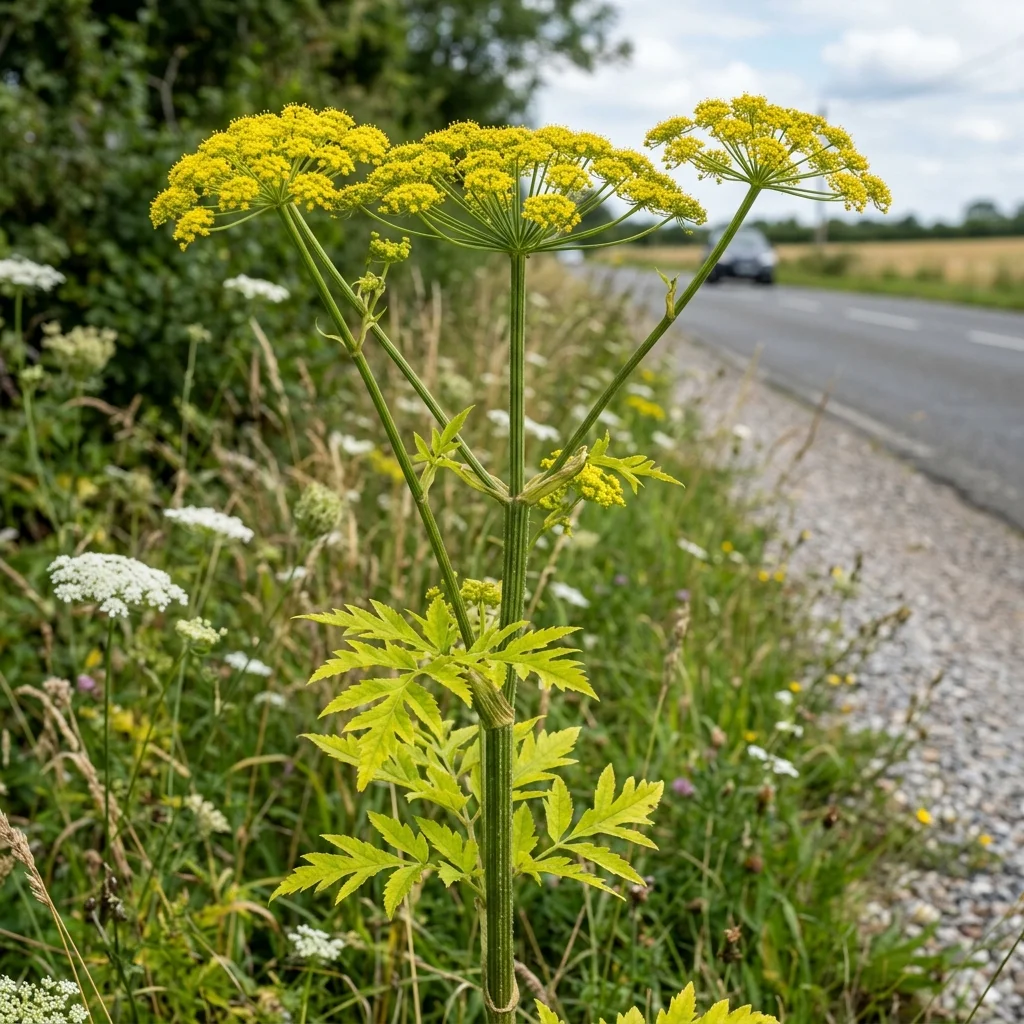
How to Identify Wild Parsnip
A tall biennial with hollow grooved stems, compound leaves with mitten-shaped leaflets, and flat umbrella-shaped yellow flower clusters.
-
✔
Mitten-Shaped leaflets: Opposite compound leaves carry 5 to 15 leaflets that are sharply toothed, frequently displaying a highly distinct 'mitten' shape with a thumb-like lobe.
-
✔
Flat Yellow Umbels: In its second year, it shoots up tall stems topped with flat, umbrella-like clusters (umbels) of tiny, bright golden-yellow flowers.
-
✔
Hollow Grooved Stems: Stems are strictly smooth (completely hairless), hollow, bright green, and heavily grooved or ribbed vertically.
Complete Care & Management Guide
Access highly technical, scientific management directives to control or cultivate Wild Parsnip effectively.
Common Diseases & Treatment
Parsnip Burn Contact
Symptoms: Skin exposed to sap develops severe redness, itching, and raised water blisters within 24-48 hours after exposure to sunlight.
Crown Regrowth
Symptoms: The flat green rosette grows back rapidly after you mowed the first-year leaves.
Frequently Asked Questions
Why does Wild Parsnip sap burn the skin?
Its sap contains furanocoumarins, which are highly phototoxic. When they touch your skin and are exposed to UV light (sunlight), they chemically bind to your cellular DNA, destroying your skin cells. This causes severe chemical burns and massive blisters.
Is Wild Parsnip really edible?
Yes! Wild Parsnip is the exact same species as the cultivated parsnips we buy in supermarkets. The first-year white taproot is highly sweet and edible. However, harvesting it is extremely dangerous due to the phototoxic sap in the leaves, and the risk of mistaking it for Deadly Water Hemlock.
How is Wild Parsnip different from Queen Anne's Lace?
Wild Parsnip always has bright golden-yellow flower clusters, and coarse compound leaves with mitten-shaped leaflets. Queen Anne's Lace always has white flower clusters with a dark-purple center flower, and highly delicate fern-like leaves.
What is the best way to eradicate Wild Parsnip organically?
Wait until early spring. Wear thick long sleeves and chemical-resistant gloves. Use a sharp spade, angle it at 45 degrees, and slice through the taproot at least 2 inches below the soil line. This separates the root crown from the root, destroying it.