Wild Violet Identification & Control
Wild Violet, also known as Common Blue Violet or Meadow Violet, is an exceptionally aggressive, tough, and beautiful perennial broadleaf weed. Native to eastern North America, it has Escaped into home lawns, shaded gardens, and valley margins. It features thick, fleshy underground rhizomes that anchor stubbornly into compacted soil, waxy heart-shaped leaves, and showy blue-violet flowers. It is highly notorious for its extreme resistance to standard lawn selective herbicides.





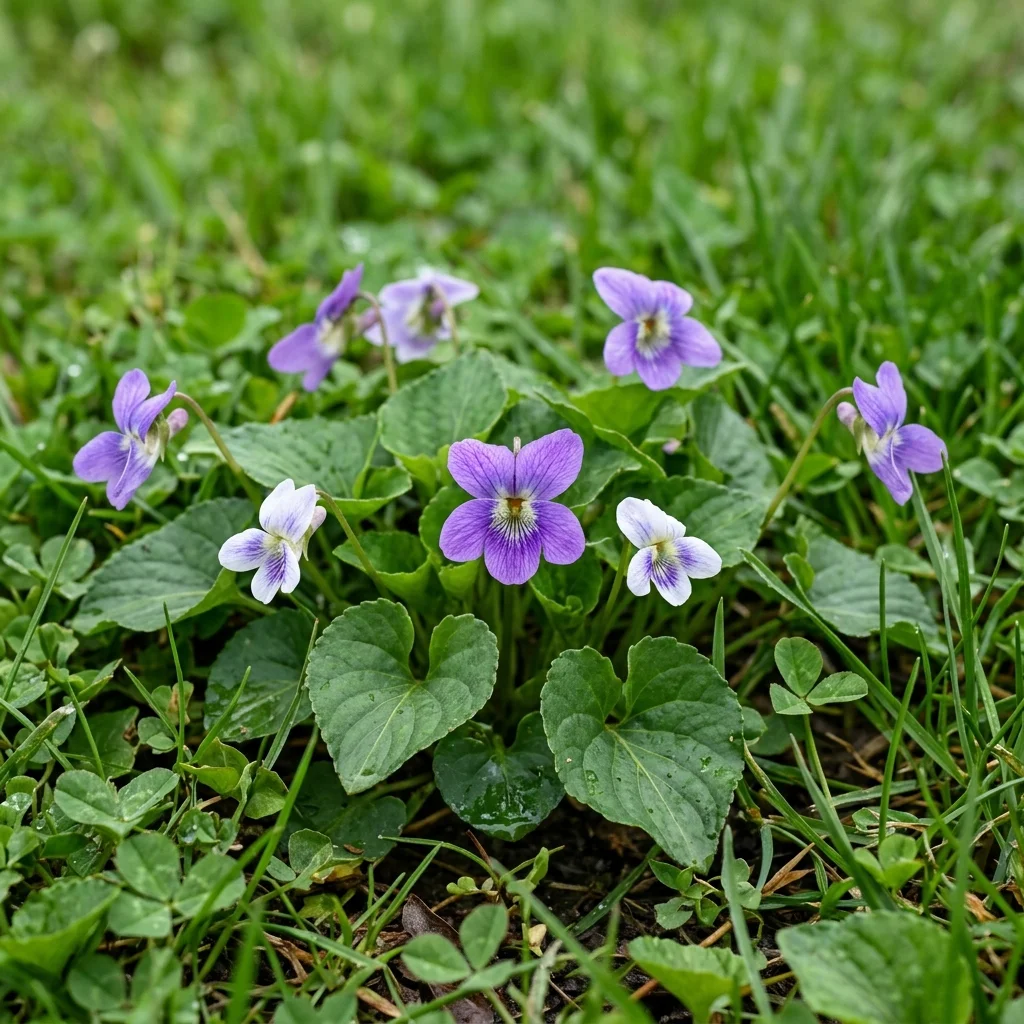
How to Identify Wild Violet
An upright perennial with a basal rosette of waxy, heart-shaped leaves, thick scaly rhizomes, and showy blue-purple flowers.
-
✔
Waxy Heart-Shaped Leaves: Leaves are broad, waxy, heart-shaped (5 to 10 cm wide) with finely scalloped margins and a distinct curl near the base.
-
✔
Showy Blue-Purple Flowers: Five-petaled flowers with a distinct, sweet violet shape, primarily colored deep blue-violet with a white throat.
-
✔
Cleistogamous Closed Flowers: Produces small, inconspicuous closed flowers near the soil surface in autumn that self-pollinate without opening.
Complete Care & Management Guide
Access highly technical, scientific management directives to control or cultivate Wild Violet effectively.
Common Diseases & Treatment
Fungal Leaf Spot
Symptoms: Circular brown spots with distinct purple borders covering the massive broad leaves.
Cleistogamous Sprout
Symptoms: Small closed flowers near the soil surface in autumn self-pollinate and shoot seeds, making weeding difficult.
Frequently Asked Questions
Why is Wild Violet so difficult to kill with herbicides?
The leaves of Wild Violet are covered in a thick, waxy cuticle that acts like a raincoat, causing liquid chemical weed killers to slide off without being absorbed. Furthermore, it regenerates quickly from its thick scaly rhizomes.
Are the flowers edible?
Yes! The flowers of Wild Violet are completely edible and highly nutritious, rich in vitamins A and C. They are widely harvested in spring to decorate gourmet salads, cakes, or made into violet jelly and teas.
What are cleistogamous flowers?
These are specialized, self-pollinating flowers that never open. Wild Violet produces them in late summer near the soil surface. They self-fertilize in complete darkness and shoot seeds up to 5 feet, bypassing bees.
What is the best way to get rid of Wild Violet organically?
Use a sharp garden spade to slice a circle around the base of the rosette. Dig deep and lift the woody yellow root crown out intact. Mow the area regularly to prevent seed production.