Witchgrass Identification & Control
Witchgrass, also known as Panic Grass or Tumble Panicum, is an exceptionally common, highly persistent annual grass weed in the Poaceae family. Native to North America, it thrives in dry sandy soils, rocky roadsides, and parched garden beds. It features thick, upright leaf blades covered in dense, fuzzy white hairs, and produces a highly unique, exceptionally large, airy purple-green seed head that resembles a massive witch's broom, which eventually breaks off and rolls like a tumbleweed to scatter seeds.





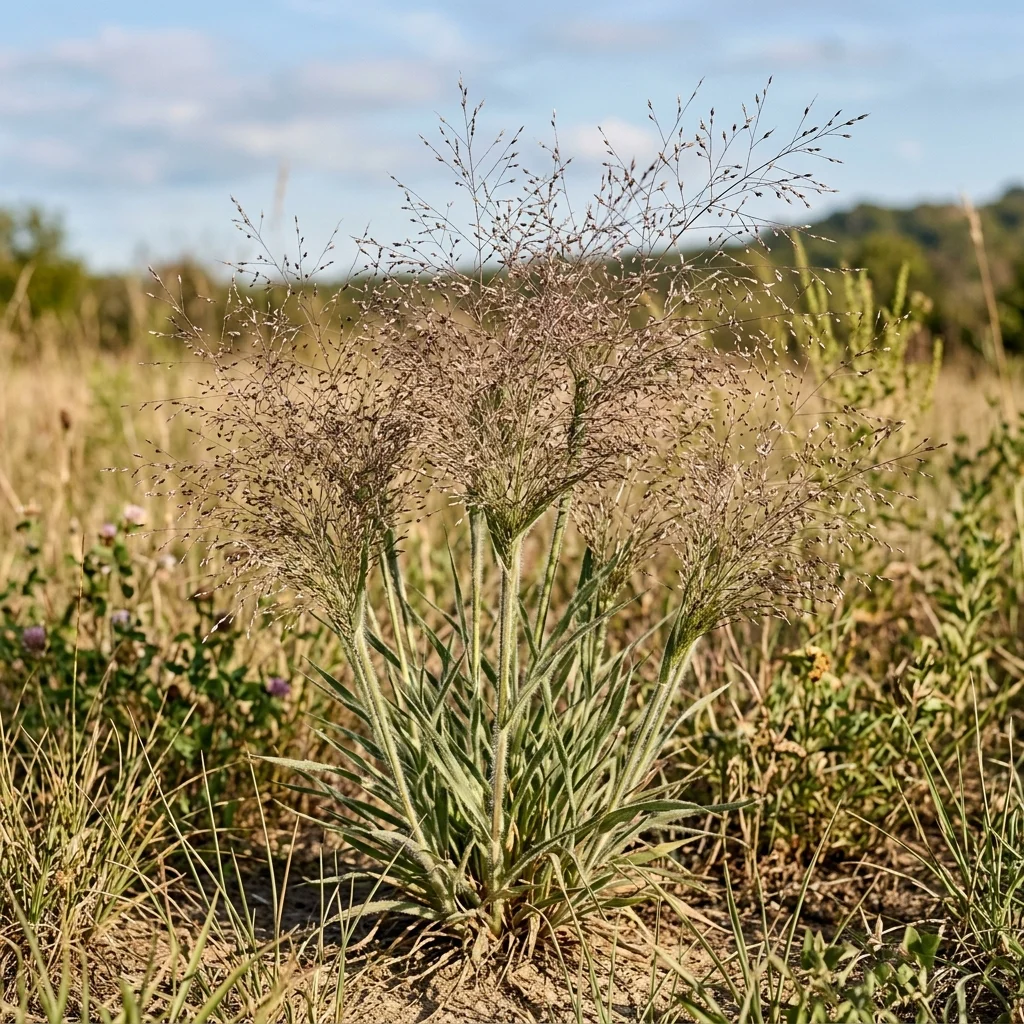
How to Identify Witchgrass
An upright, clump-forming annual grass with leaf blades and sheaths covered in dense, fuzzy white hairs, and exceptionally large, airy, fan-like seed heads.
-
✔
Airy Witch-Broom Seed Heads: Massive, highly branched, airy purple-green circular seed plumes (up to 40 cm long) composed of delicate wiry stems.
-
✔
Densely Fuzzy Leaves: Stiff green leaf blades (8 to 25 cm long) and leaf sheaths are covered in dense, long, fuzzy, white hairs.
-
✔
Spreading Clumping Culms: Upright culm stems grow in tight clumps, branching from the base and reaching up to 3 feet tall.
Complete Care & Management Guide
Access highly technical, scientific management directives to control or cultivate Witchgrass effectively.
Common Diseases & Treatment
Tumbleweed Dispersion
Symptoms: Massive, dry wiry purple seed plumes break off and roll across your lawn, dispersing seeds.
Fuzzy Leaf Transpiration
Symptoms: Thick green grass leaves remain upright and healthy during extreme heatwaves, outcompeting lawn turf.
Frequently Asked Questions
Why is it called 'Witchgrass'?
It is named Witchgrass because its huge, highly branched, airy seed head looks like a tangled, messy nest of wiry purple-green hair, resembling the mythical messy broom or hair of a witch.
How is Witchgrass different from Crabgrass?
Witchgrass is covered in dense, long, soft, fuzzy white hairs on both its leaf blades and sheaths, and has a massive, airy seed plume. Crabgrass is mostly hairless or has hairs only at the leaf base, with finger-like seed spikes.
Is Witchgrass toxic to dogs?
No, it is completely non-toxic and pet-safe. However, the dry wiry seed plumes can get tangled in long-haired pet fur, causing minor matting and discomfort.
What is the best way to get rid of it?
Because it has a very shallow fibrous root system and lacks stolons, it pulls up effortlessly by hand. Hand-weed in early summer before the airy seed heads mature and snap off to roll.