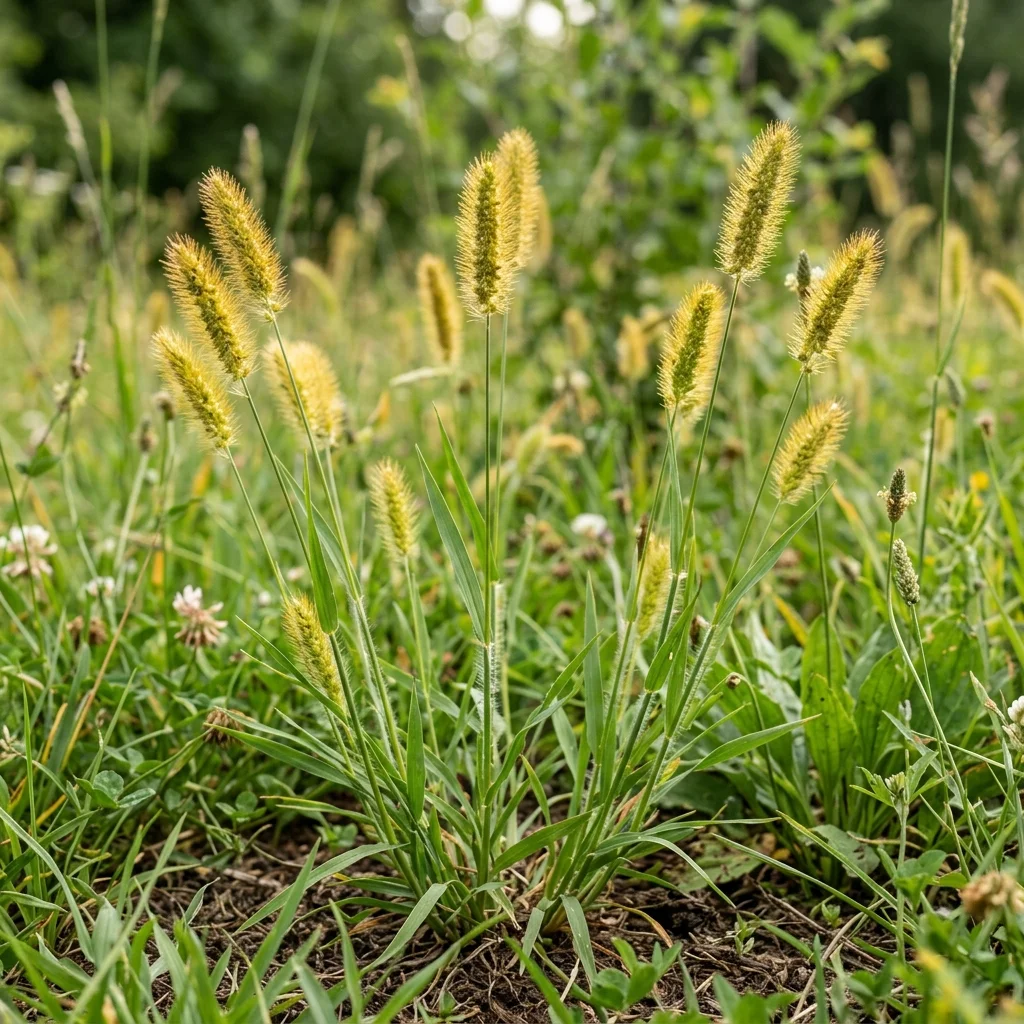
Setaria pumila

Yellow Foxtail Identification & Control

Yellow Foxtail, also known as Pigeon Grass or Golden Foxtail, is an exceptionally common, highly aggressive summer annual grass weed in the Poaceae family. Globally distributed, it is a major headache for lawns, crop fields, and cattle pastures. Growing in dense clumps up to 3 feet tall, it features flat green leaf blades showing unique, long white hairs at the collar. It is famed for its bristly, cylindrical, bottle-brush seed spikes covered in dense, golden-yellow bristles with sharp, backward-pointing awns that easily cling to animal fur and cause severe ear and throat injuries to pets.


Sunlight Icon
Sunlight Full Sun to Partial Shade
Watering Icon
Watering Tolerance Low to Moderate
Soil Mix Icon
Soil Adaptability Any Soil / Loam / Dry Clay / Sandy
Temperature Icon
Growth Temp 10°C - 38°C
Toxicity Danger Icon
Danger / Toxicity Danger / Barbed Awns / Pet Injury
Botanical macro photography of Yellow Foxtail (Setaria pumila) - Plant AI care and control database

How to Identify Yellow Foxtail

An upright annual grass forming green clumps, with flat leaves showing long white hairs at the base, and bristly golden-yellow bottle-brush seed heads.

  • Golden-Yellow Bristly Spike: Erect, dense, cylindrical bottle-brush seed heads (3 to 10 cm long) packed with bright yellow-orange bristles.
  • Long White Collar Hairs: The base of the flat green leaf blade, where it wraps the stem (sheath collar), features highly distinct, long, twisting white hairs.
  • Flat Green Culms: Upright culm stems are flattened at the base, smooth, branched, and frequently showing a purple tint near ground level.
⚠️ Pet & Livestock Warning: The golden bristles of Yellow Foxtail are armed with sharp, backward-pointing barbed awns! If a dog walks through dry foxtails, the awns can easily drill into their ears, eyes, or between toes, requiring surgery.

Complete Care & Management Guide

Access highly technical, scientific management directives to control or cultivate Yellow Foxtail effectively.

Highly adapted to dry and damp conditions. It grows vigorously in early spring moisture but survives dry spells by accelerating its seeding cycle, producing seeds and dying in summer.
Resistant to mowing. Regular mowing will clip the tall stems and limit seed formation, but the plant will quickly shoot up new stems from its creeping yellow rhizomes.
An extreme nitrogen accumulator. It actively absorbs high levels of soil nitrates, starving nearby vegetable crops. Avoid over-fertilizing infested beds.
Highly versatile. Thrives in Full Sun but exhibits moderate shade tolerance, allowing it to colonize shaded pathway margins and compact orchard margins.
Adapts to clay, rich loam, sandy loam, and gravelly forest edges, provided the substrate is well-drained. It struggles in swampy soils.
Reproduces strictly by seeds. The seed pods explode when dry, flinging seeds up to 10 feet horizontally. A single plant can produce thousands of seeds.
A summer annual. Seeds germinate rapidly in late spring when soil temperatures reach 65°F (18°C). The entire plant dies with the first winter frost.
Features an exceptionally shallow, delicate, fibrous root system. Due to shallow rooting, it is very easy to pull out by hand or scrape with a hoe.
Occasionally targeted by aphids, but pests rarely cause significant damage to this highly robust annual grass.
Rarely suffers from diseases, though damp autumns can bring mild leaf rust spots that fail to kill the plant before it drops seeds.
To control Yellow Foxtail organically, manually dig up young rosettes in spring before they flower, use a hoe to scrape seedlings, and mulch garden beds heavily to block seed light.

Are your lawn margins showing green grass clumps with golden bottle-brush spikes?

Mow high to shade the soil, hand-pull the grass clumps before spikes turn golden-yellow, and keep dogs away.

Diagnose Weed Instantly

Common Diseases & Treatment

Foxtail Awn Puncture

Symptoms: Symptoms: The barbed golden bristles lodge deep in your dog's ears, eyes, nose, or between toes, causing swelling and pain.

Action: Action: Emergency vet visit! Barbed awns can drill inward through flesh; do not try to pull them out with tweezers if they are deep.

Barbed Seed Spread

Symptoms: Symptoms: Cylindrical yellow bottle-brush spikes dry out and shatter, dropping thousands of barbed seeds into sandy lawns.

Action: Action: Mow before the spikes turn golden-yellow to prevent seed shattering. Apply pre-emergent organic corn gluten meal.

Frequently Asked Questions

Why is it called 'Yellow Foxtail'?

It is named Yellow Foxtail because its seed spike looks like a bushy, cylindrical tail of a small fox, and the dense, stiff bristles covering the seeds turn a highly distinct, brilliant golden-yellow at maturity.

Why are foxtails so dangerous for dogs?

The seed awns are shaped like arrows with tiny backward barbs. Once they enter a dog's ear canal, nose, or paw skin, they can only move forward, drilling deep into the animal's flesh, causing severe internal infections and requiring surgery.

How do you distinguish Yellow Foxtail from Green Foxtail?

Yellow Foxtail (Setaria pumila) has seed head bristles that turn a bright golden-yellow, and features long, prominent white hairs at the leaf blade base. Green Foxtail (Setaria viridis) has solid green bristles and completely hairless leaf bases.

What is the best way to get rid of it?

Because it has a shallow fibrous root system, it is very easy to pull out by hand before it flowers. Mow high (3+ inches) to keep your lawn grass dense, which shades out emerging summer seedlings.

No more dying plants. Grow healthy greens today!

Get Started for Free