Yellow Toadflax Identification & Control
Yellow Toadflax, botanically known as Linaria vulgaris and commonly nicknamed 'Butter-and-Eggs', is an exceptionally aggressive, highly persistent perennial broadleaf weed in the Plantaginaceae family. Native to Europe but thoroughly invasive globally, it is a severe threat to rangelands, pastures, and residential garden borders. It features upright stems densely covered in narrow, linear, pale-green leaves, and produces showy spikes of bright yellow, snapdragon-like flowers with a prominent orange throat. It spreads aggressively via a massive network of deep, creeping lateral roots that release allelopathic compounds, outcompeting native forage and containing toxic glucosides that are highly unpalatable to livestock.





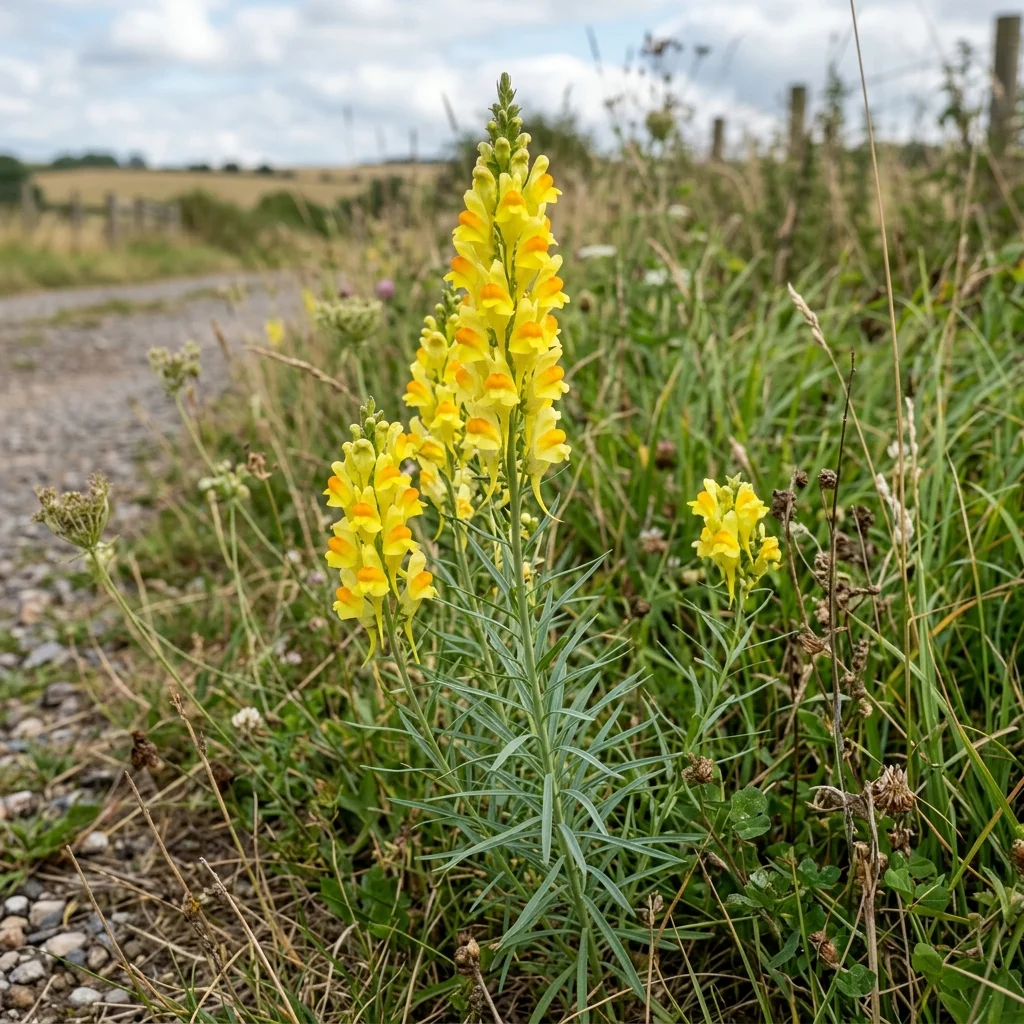
How to Identify Yellow Toadflax
An upright perennial with narrow linear leaves, and dense spikes of snapdragon-like, bright yellow flowers showing orange throats.
-
✔
Snapdragon-Like Flowers: Showy flowers (2 cm long) have a bright yellow tube with exactly two lips and a prominent waxy orange throat cushion ('butter-and-eggs').
-
✔
Narrow Linear Leaves: Numerous pale-green, smooth, narrow linear leaves (2 to 6 cm long) are arranged alternately and densely along the upright stems.
-
✔
Upright Smooth Stems: Stems are erect, smooth, hollow (growing up to 2.5 feet tall), and occasionally branched at the top.
Complete Care & Management Guide
Access highly technical, scientific management directives to control or cultivate Yellow Toadflax effectively.
Common Diseases & Treatment
Glycoside Pasture Avoidance
Symptoms: Pastures are heavily invaded by yellow toadflax because cattle refuse to graze the toxic, highly bitter leaves, leading to forage starvation.
Deep Lateral Spreading
Symptoms: Toadflax patches expand in circular mats in garden beds, returning vigorously despite shallow hand-pulling.
Frequently Asked Questions
Why is it nicknamed 'Butter-and-Eggs'?
It is named after its highly unique yellow and orange flower color scheme. The waxy bright-yellow petals resemble butter, while the waxy orange central bulge resembles an egg yolk.
Is Yellow Toadflax poisonous to cattle?
Yes. It contains toxic glucosides that are highly bitter and toxic to livestock. Grazing cattle, horses, and sheep avoid it, allowing the weed to quickly dominate pastures.
How do these flowers pollinate?
The snapdragon lips are closed so tightly that only heavy-bodied bumblebees are strong enough to push open the waxy lips and reach the deep nectar spur.
What is the best way to get rid of it?
Excavate the white lateral root chains completely using a garden spade in early summer, and mow repeatedly to prevent seed production.