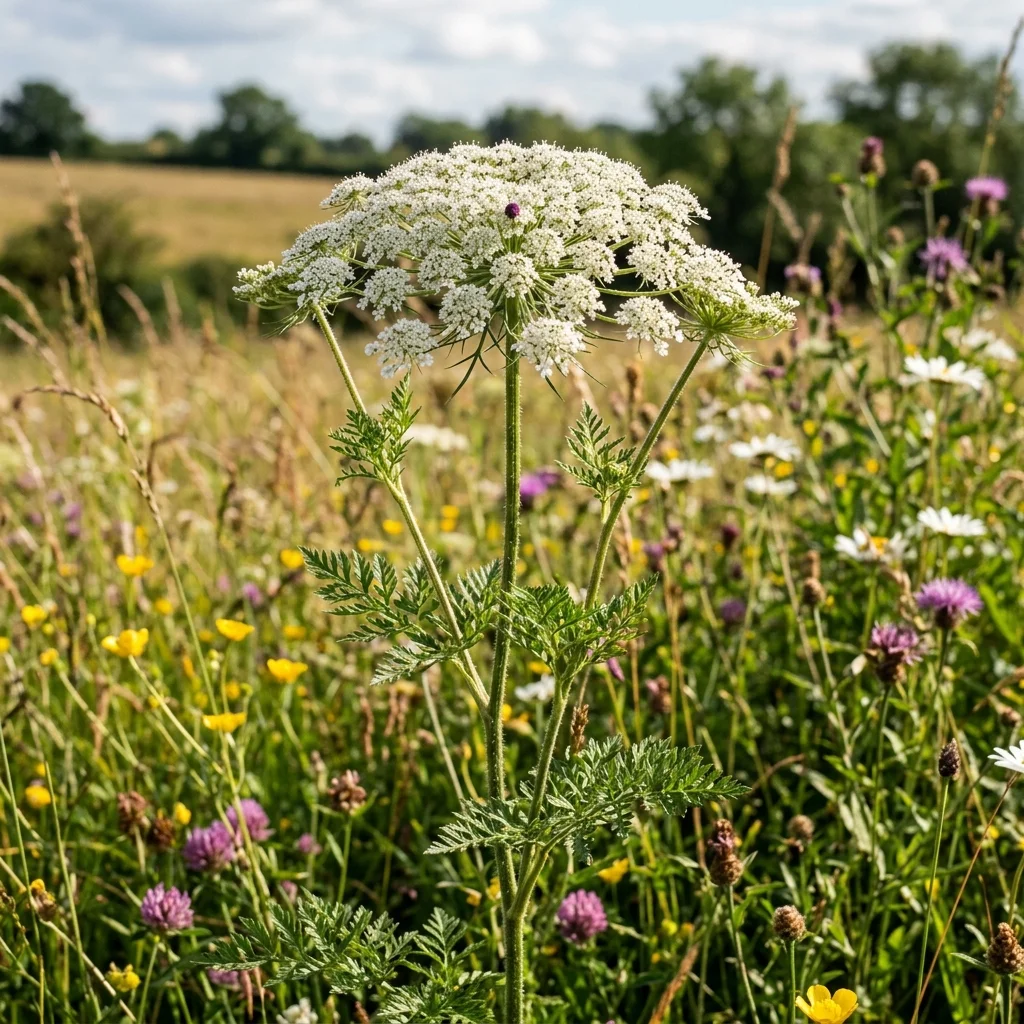
Daucus carota

Wild Carrot Identification & Control

Wild Carrot, also globally known as Queen Anne's Lace or Bishop's Lace, is a highly common, resilient biennial broadleaf weed in the parsley family. Famed for its highly delicate, lace-like white flower heads and carrot-scented taproot, it has colonized pastures, roadsides, and home gardens across North America. In its second year of growth, it shoots up tall, hollow flower stalks topped with flat, lace-like umbels of tiny white flowers, featuring a single, distinct dark-purple flower in the center.


Sunlight Icon
Sunlight Full Sun to Partial Shade
Watering Icon
Watering Tolerance Low to Moderate
Soil Mix Icon
Soil Adaptability Dry Clay / Sandy / Poor Soil / Any
Temperature Icon
Growth Temp 8°C - 35°C
Toxicity Danger Icon
Danger / Toxicity Pet Safe / Poison Lookalike Warning
Botanical macro photography of Wild Carrot (Daucus carota) - Plant AI care and control database

How to Identify Wild Carrot

A tall biennial with a basal rosette of fern-like leaves, a carrot-scented taproot, and flat, lace-like white umbels with a dark-purple center flower.

  • Lace-Like White Umbels: In its second year, it produces flat, umbrella-like clusters (5 to 10 cm wide) of tiny white flowers, looking like delicate lace.
  • Dark-Purple Center Flower: The very center of the white lace cluster features a highly unique, single, tiny, dark-purple or reddish-purple flower.
  • Fern-Like Hairy Stems: Stems are hollow, covered in stiff hairs, and leaves are deeply divided, fine, and fern-like, smelling like carrots when crushed.
⚠️ DEADLY LOOKALIKE WARNING: Queen Anne's Lace looks almost identical to the **Deadly Poison Hemlock** (*Conium maculatum*) and **Water Hemlock**! Always inspect the stem: Queen Anne's Lace has a **hairy green stem**, while Deadly Poison Hemlock has a **smooth, hairless stem with purple spots**. Touching poison hemlock can be fatal.

Complete Care & Management Guide

Access highly technical, scientific management directives to control or cultivate Wild Carrot effectively.

Highly drought-tolerant once established due to its deep taproot. It thrives in dry, sunny fields and dry clay lawn edges where water is scarce.
Controlled effectively by mowing in its second year. Mowing cuts off the tall flower stalks before they can set seed, preventing propagation.
Thrives in nutrient-poor and dry soils. It has a high phosphorus extraction rate. Regular fertilization of grass helps choke out emerging seedlings.
Prefers Full Sun to partial shade. It struggles under dense forest shade and dense, thick lawn turf shading. Shading lawns suppresses it.
Adapts to sandy, clay, gravelly, and nutrient-poor garden soils, provided the substrate is well-drained. It struggles in swampy soils.
Spreads aggressively strictly by seeds. After flowering, the flat lace head curls upward to form a cup resembling a bird's nest packed with prickly seeds.
A biennial. First year is a flat green rosette that survives freezing winter frosts easily. The second year it flowers, seeds, and dies completely in autumn.
Features a deep, vertical, tough white taproot that smells strongly of domestic carrots. Manual extraction requires a spade to dig the root intact.
Occasionally targeted by parsley worms and swallowtail butterfly caterpillars, which feed heavily on the fern-like leaves, acting as a natural control.
Subject to **Aster Yellows** and **Fungal Blights**, though diseases rarely kill the tough taproot crown before it successfully seeds.
To control Wild Carrot organically, manually dig up first-year rosettes with a weeding tool, and mow down second-year flower stalks as soon as they bloom to prevent seeding.

Is your garden showing fern-like leaves or flat, lace-like white flower heads?

Mow early to cut off lace heads before seeding, dig out first-year taproots, and verify hairy stems.

Diagnose Weed Instantly

Common Diseases & Treatment

Aster Yellows

Symptoms: Symptoms: Leaves turn stunted and yellow, and the lace-like white flowers become deformed and greenish-yellow.

Action: Action: Immediately pull and discard infected plants. This disease is spread by leafhoppers and can infect garden carrots and lettuce.

Bird's Nest Curling

Symptoms: Symptoms: The white lace head curls tightly inward as it dries, forming a brown, cup-like structure packed with prickly seeds.

Action: Action: Cut off the curled brown seed heads using shears and discard them in a trash bag. Do not compost seeded heads.

Frequently Asked Questions

Why is it called 'Queen Anne's Lace'?

Legend says Queen Anne of Great Britain pricked her finger with a needle while tatting white lace. A single drop of her dark-red blood fell in the center, represented by the single, tiny dark-purple flower in the middle of the lace head.

Are the roots edible?

Yes, Wild Carrot is the direct wild ancestor of our domestic garden carrots. The first-year white taproot is edible and smells like carrot, but is very fibrous and tough. *WARNING*: Never eat wild roots due to the deadly similarity to Poison Hemlock.

How do I tell it apart from the deadly Poison Hemlock?

Remember this rule: 'The Queen has hairy legs.' Queen Anne's Lace stems are covered in dense, stiff hairs, and are solid green. Deadly Poison Hemlock stems are completely smooth (hairless), hollow, and covered in distinctive purple spots.

What is the best way to get rid of it?

For first-year rosettes, use a weeding fork to dig up the white taproot. For second-year plants, cut down the flower stalks when they bloom in summer to prevent them from seeding, breaking the biennial lifecycle.

No more dying plants. Grow healthy greens today!

Get Started for Free